
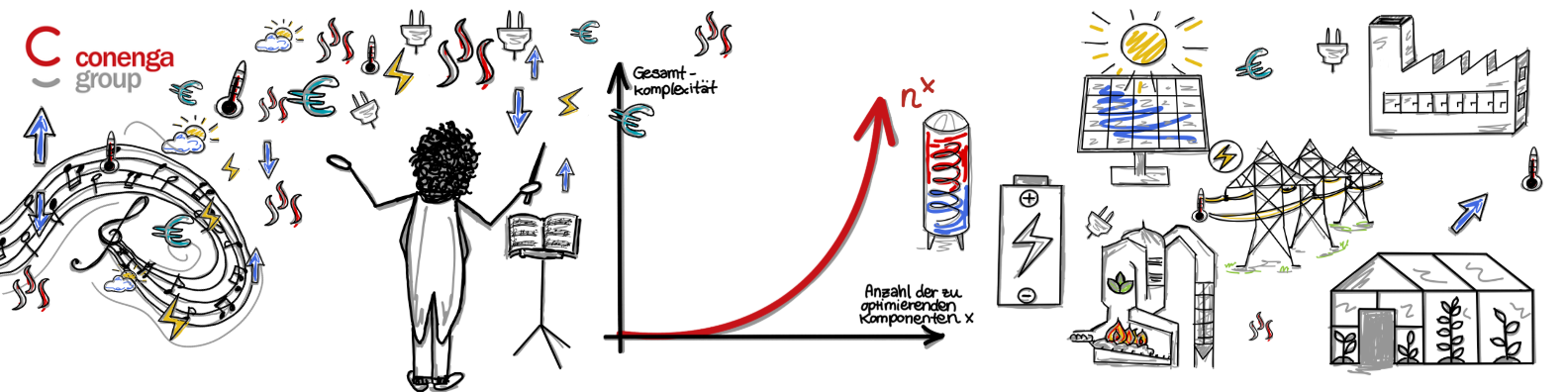

Key Takeaways:
- Operating rules reach their limits in complex energy systems.
- Solvers find the optimal solution from among many possible operating scenarios.
- In doing so, they simultaneously take into account plants, storage facilities, prices, and technical constraints.
- The site model provides the basis for optimization.
- This enables cost-effective real-time operation.
In many industrial companies, facilities have been gradually optimized over the years. Even if individual subsystems are operated efficiently, the facility as a whole may still be far from its economic optimum.
This may be due to complex interdependencies between the systems, time-dependent costs and revenues, or the need to take forecasts into account. Thus, operating a boiler that is less efficient on its own may make economic sense in certain situations if fuel prices, power generation linkages, or storage conditions meet defined criteria.
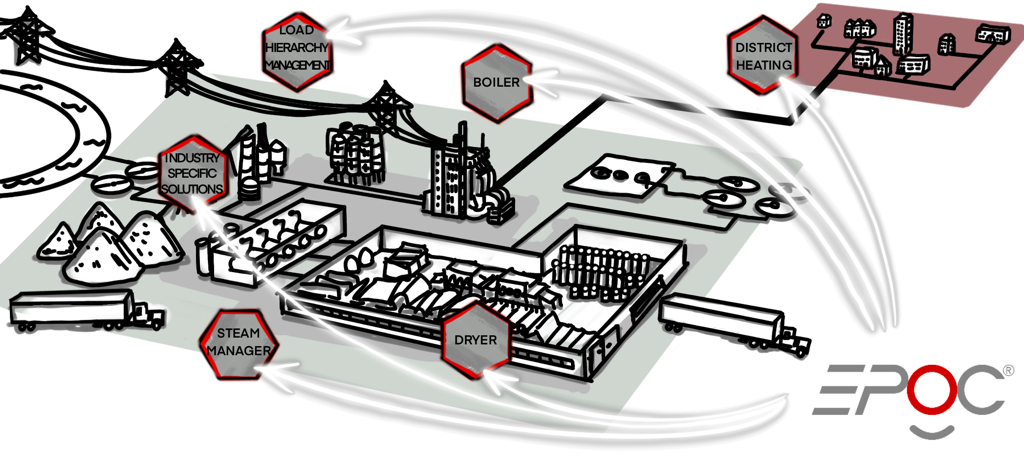
Process-level site optimization and higher-level control via the EPOC® Suite
A site-wide optimization system enables the transition from a local optimum (e.g., operating a heat pump at maximum COP) to a global optimum (e.g., operating during the most cost-effective times, even if the machine is temporarily less efficient during those periods).
The Location Model
In addition to production facilities, a typical industrial site has various energy sources, steam generators, storage systems, and electricity supply sources. Each of these components is subject to technical and economic constraints, such as minimum loads, efficiency levels, start-up and shutdown times, fuel costs, and emissions.
On the demand side, energy demand and prices at a given location fluctuate both throughout the day and over the long term. In addition, the pricing of emissions is becoming increasingly important.
In contrast to process-oriented optimization (which unit operates most efficiently?), the question from the plant’s perspective is therefore which combination of all available units is economically optimal at any given time.
Operating rules become an optimization problem
This site-wide challenge is not new and has, in many cases, been addressed through defined operating rules. There is a reason why these rules worked well in the past but are now increasingly reaching their limits: the complexity of the overall system is increasing significantly due to dynamic pricing and the integration of energy storage systems.
For example, while the decision between a boiler and a combined heat and power (CHP) unit could previously be made without further conditions by comparing the effective heat generation costs at time t , the introduction of a heat storage system and fluctuating electricity prices means that this decision suddenly also depends on the future states t+1, t+2, … of all linked systems.
If well-known constraints such as minimum durations or pickup and drop-off costs are also to be taken into account in the decision-making process, a comprehensive, dynamic optimization problem has emerged from the clearly defined operating rules.
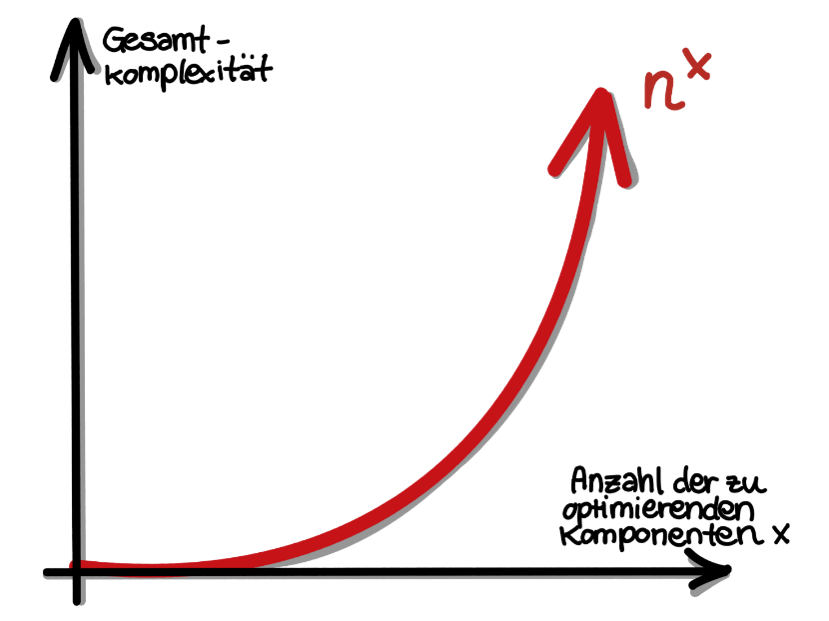
Exponential increase in the number of theoretically possible schedules for n operating modes and x components
Whereas the number of defined, distinct operating modes could previously usually be counted on one hand, the theoretical possibilities explode—due to the resulting degrees of freedom—even with just a small number of systems to be controlled over the next few hours. (For example, with hourly control such as On/Off or increasing/decreasing power, 4 components result in296 theoretical operating schedules over the next day.)
Since even high-performance computers cannot simply “try everything” given this number of possibilities, specialized optimization solvers are used, which reduce the complexity of the overall problem through a variety of measures, thereby making it solvable in real time. Depending on the problem at hand, methods such as linear optimization models, mixed-integer optimization, or nonlinear optimization are used.
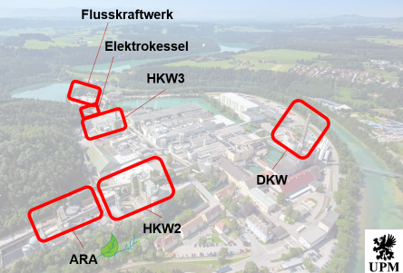
Site optimization at the process level and at higher levels using the EPOC® Suite at UPM Schongau
In practice, the solver is rarely the biggest problem
A significant part of the work usually involves modeling the industrial site with sufficient accuracy. This requires, on the one hand, reliable measurement data and, on the other hand, knowledge of operational constraints.
Some limits can be derived from technical documentation, while others exist only as empirical knowledge held by operating personnel. Bringing these together, verifying them step by step, and critically evaluating them on an iterative basis is one of the key steps toward site-wide optimization.
For successful closed-loop optimization, this must be formulated as a single, integrated problem. In doing so, optimization parameters and time horizons must be selected appropriately so that both the required granularity is achieved and the maximum execution times are adhered to.
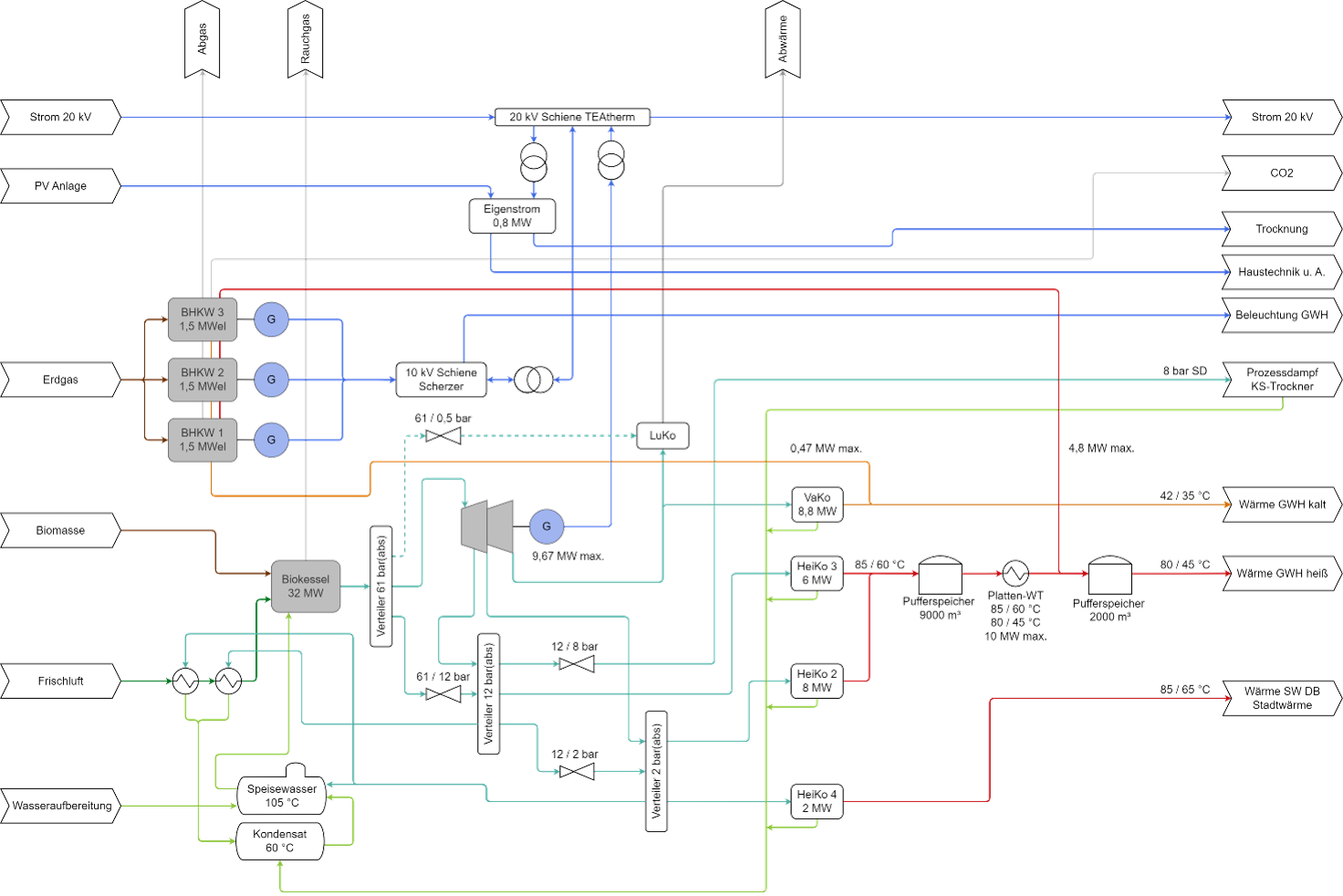
Overarching Steam and Heat Network Optimization Using the EPOC® Steammanager and EMS Modules
From an Efficient Process to an Optimized Location
A change in perspective is therefore essential for unlocking a location’s potential: rather than focusing solely on operating individual units as efficiently as possible, the industrial location must be viewed as an integrated system.
This makes it possible to systematically leverage the interdependencies between production, power converters, storage systems, and electricity prices.
The focus shifts from local plant optimization to the optimal operating point of the entire site.

Dipl.-Ing. Sebastian Sturm
Senior Consultant Advanced Process Control (APC), CONENGA Group
Dipl.-Ing. Sebastian Sturm ist Senior Consultant im Bereich Advanced Process Control (APC) bei der CONENGA Group und verantwortet seit 2023 als Team Lead die Weiterentwicklung datenbasierter Regelungs- und Optimierungslösungen für industrielle Energieanlagen. Sein Schwerpunkt liegt auf der Entwicklung komplexer Regelungsstrategien, der Analyse von Prozessdaten sowie der Integration moderner Cloud- und Data-Science-Technologien in industrielle Automatisierungssysteme.
Seit 2019 arbeitet er bei CONENGA an der Entwicklung und Implementierung fortschrittlicher Regelungssysteme für Energie- und Industrieanlagen. Dabei verbindet er Methoden der modellbasierten Regelungstechnik mit datengetriebenen Analyseverfahren, um Effizienz, Stabilität und Emissionsverhalten komplexer Prozesse nachhaltig zu verbessern.
Dipl.-Ing. Sturm studierte Technische Physik sowie Energie- und Automatisierungstechnik mit Schwerpunkt Energietechnik, Energiewirtschaft und Umwelt an der TU Wien. Bereits während seines Studiums beschäftigte er sich intensiv mit Energiesystemanalyse, Kraftwerkseinsatzplanung und der Optimierung von Energiesystemen.
Vor seiner Tätigkeit bei CONENGA sammelte er praktische Erfahrung in der Analyse von Prozessdaten, Investitionsrechnungen und Szenarienanalysen für Industriekraftwerke. Zudem war er in verschiedenen Projekten zur Entwicklung von Optimierungsmodellen für Energie- und Kraftwerkssysteme tätig, unter anderem im Umfeld von Energiehandel und Kraftwerksbetrieb.
Seine Arbeit verbindet fundierte Kenntnisse der Regelungstechnik, Datenanalyse und Softwareentwicklung mit praxisorientierten Engineering-Lösungen für moderne Energie- und Industrieanlagen.
Expertise
-
Advanced Process Control (APC) und modellbasierte Regelung
-
Datenanalyse und Prozessoptimierung für Energieanlagen
-
Cloud-basierte Industrieanwendungen und Data Science
-
Entwicklung komplexer Regler auf Automatisierungsplattformen
-
Energiesystemanalyse und Kraftwerkseinsatzplanung
-
Softwareentwicklung für technische Anwendungen
Fokusbereiche bei CONENGA
-
Entwicklung und Implementierung intelligenter Regelungssysteme
-
Optimierung von Biomasse- und Energieanlagen
-
Datenbasierte Prozessanalyse und Modellierung
-
Integration von Cloud-Technologien in industrielle Systeme
-
Technische Leitung von APC- und Optimierungsprojekten