

Key Takeaways:
- Through the EDGE-AI 4 APC research project, the CONENGA Group is specifically advancing the development of its APC modules and combining edge computing with AI technologies for industrial applications.
- Edge integration enables data processing directly at the plant site and lays the foundation for real-time capabilities, high data security, offline operation, and easy scalability.
- AI methods such as anomaly detection, predictive models, and computer vision help make plant operations more efficient, safer, and more reliable.
- The CONENGA Group combines edge computing and AI to create powerful edge AI solutions that make modern analytics and optimization techniques available directly in the industrial setting.
- All developments are validated under real-world operating conditions and refined into market-ready products to provide sustainable added value to power plant and industrial operators.
EDGE-AI 4 APC
For us at the CONENGA Group, research and development has a clear goal: we want to create genuine, lasting value for both ourselves and our customers through the consistent refinement of existing products and research into new approaches and products.
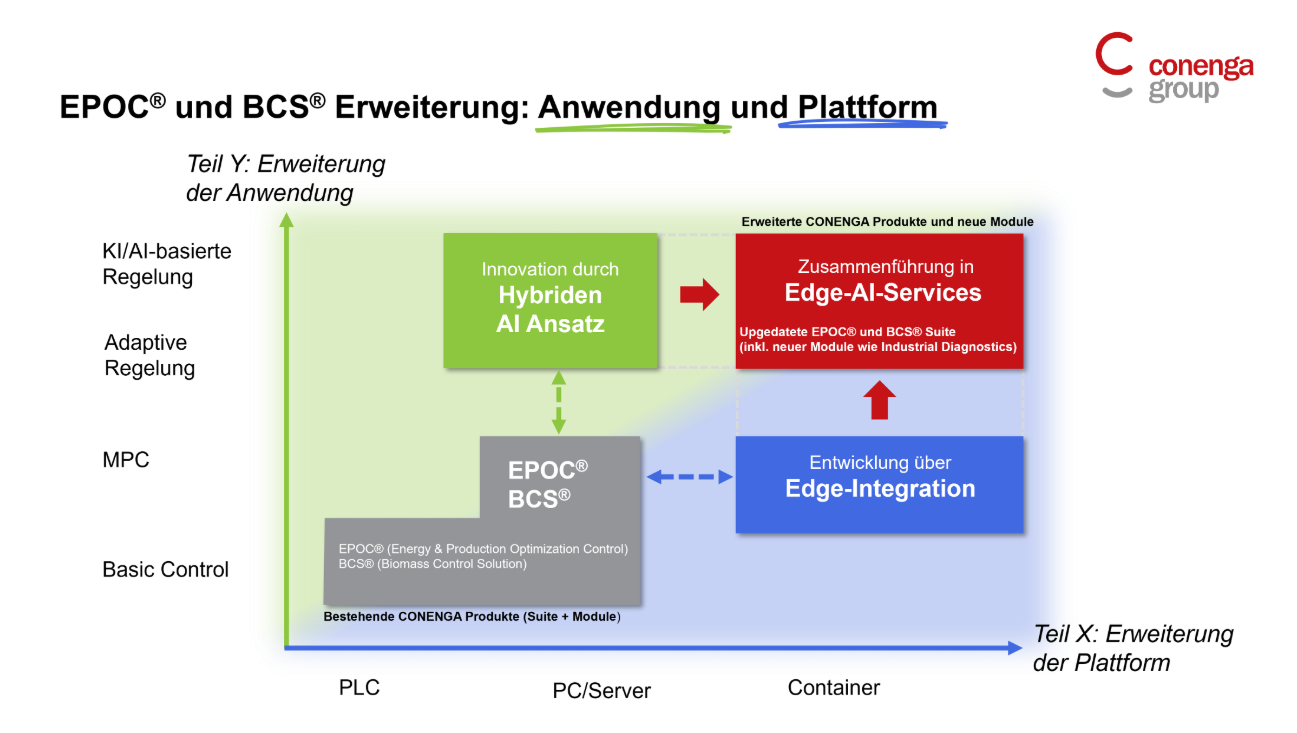
As part of the EDGE_AI_4_APC research project, funded by the Vienna Business Agency, we are able to advance these ideas in a highly targeted manner for our APC modules. The project focuses primarily on innovation in two areas:
- Part X: Edge Integration, through the further development of APC products into executable, containerized applications on edge devices
- Part Y: Hybrid AI Implementation, through the integration of AI methods (neural networks, machine learning, etc.) into APC products
These two parts are combined in a third step:
- Part X+Y: Edge AI Services, achieved by combining both developments for the respective APC products and new modules
But what exactly does edge integration mean, and what approaches to hybrid AI deployment are we pursuing here?
Edge Computing in Industry: Here to Stay
Edge computing refers to the execution of computations, data analysis, and data storage close to the data sources—for example, directly at an industrial site. While the early stages of Industry 4.0 developments were clearly dominated by cloud computing—that is, outsourcing data processing to the Internet and central servers—a clear trend toward on-site processing (at the network edge) is now evident. Among other things, this offers the following advantages:
- Real-time Capability: Processing data directly at the source reduces latency, enabling the execution of time-sensitive tasks.
- Scalability: Edge containers can be deployed on individual devices or on up to thousands of edge nodes
- Security: Local data processing makes it easier to comply with IT security requirements (e.g., NIS-2)
- Offline capability: Applications continue to run even during temporary network outages, which is particularly important for critical infrastructure (energy utilities)
In particular, the increasing processing power of edge devices—typically small industrial PCs—is enabling the growing use of edge computing in place of (or in conjunction with) cloud computing.
In addition to the hardware, it is also necessary to package the application software as a standalone container. A software container is a standardized, self-contained software unit that includes not only the application code but also all necessary dependencies (libraries, system tools, etc.). This allows the containerized application to run reliably on various computer environments, including edge devices. The advantages of this are:
- Portability: The application runs the same everywhere, regardless of the underlying hardware configuration
- Efficiency: More resource-efficient and faster than virtual machines
- Consistent Management: Since containers run the same way on all machines, managing them (deployment, starting, stopping) is independent of the application and easy to automate.
Through full edge integration, a software module can thus be packaged as a container and deployed directly on one (or more) desired edge devices without any additional effort, from which it then performs the calculations and analyses.
Where AI Services Can Help
AI approaches are also being used more and more in industry—for example, for modeling, optimization, and control, as well as for diagnostics and monitoring—and machine learning methods continue to gain importance. More powerful hardware, more efficient algorithms, more data that is more readily available, and growing confidence in these tools will continue to drive demand for AI services in the future.
We at the CONENGA Group see potential for power plant and energy facility operators primarily in the following areas of application:
- Data Modeling and Forecasting
- Image Recognition or Computer Vision
- Pattern Recognition and Anomaly Detection
With the help of tools such as neural networks, regression models, or hybrid models, it is possible to increase plant performance, improve efficiency, and better manage complex plant conditions or nonlinearities. Image recognition tools, on the other hand, open up new possibilities for monitoring process conditions and for fault diagnosis. Anomaly detection and predictive maintenance models continuously analyze process data, identify potential problems early on, and assist with plant control and maintenance.
The integration of edge computing with AI services (also known as edge AI) makes it possible to combine the advantages of both approaches to reliably deploy advanced, state-of-the-art AI models directly at industrial sites.
Product Spotlight
As part of the project, various modules and products from the CONENGA Group’s portfolio are being further developed—such as fire detection—and new ones are being created, for example, the Industrial Diagnostics module for anomaly detection.
Industrial Diagnostics / Anomaly Detection
The goal of the Industrial Diagnostics module is to detect anomalies and deviations in the operation of combustion power plants. To this end, an AI model of the plant—developed using data-driven methods—monitors ongoing operations in real time to detect potential problems such as signal errors, sensor drifts, or process anomalies at an early stage. This makes it possible to increase the power plant’s efficiency, reliability, and safety.
The Industrial Diagnostics module is connected to the power plant’s control system as an edge module to collect real-time data from sensors and control systems. This data is continuously fed into the plant model and analyzed. The module includes the following key components:
- Data Integration and Preprocessing: Collection and Processing of Real-Time Data
- Anomaly Detection: Identification of Deviations and Anomalous Patterns
- Diagnostics, Fault Analysis, and Visualization: Support for Operations Management
- Integration into existing systems: seamless connection to SCADA and control systems
Fire position detection
TheEPOC®SuiteFire Position Detection Module is an image-based system for the automated detection of the fire position and the burn-out zone in grate-fired combustion plants. The fire position in the combustion chamber is a key indicator of combustion quality, efficiency, and emissions behavior. Today, the fire position is primarily assessed manually or using indirect parameters (temperatures, O₂ levels). Direct, camera-based detection and analysis enables:
- Real-time detection of the fire’s location and spread
- Early warning of uneven distribution (uneven burning, slag formation)
- Direct feedback into the plant control system (grate/fuel feed)
Real-time analysis of camera images replaces manual monitoring by plant personnel, enabling a precise and objective assessment of the combustion conditions.
The system uses commercially available network cameras with RTSP support that continuously monitor the fire chamber. The in-house fire detection system analyzes the video stream in real time and determines the exact position of the fire or the edge of the burn zone.
- Data Processing: The measured values are transferred to a database and/or the process control system and are available for analysis.
- Visualization: Optionally, the detected fire situation can be visualized in the image stream
- Control Integration: When combined with a fire-rate control system such asEPOC® Boiler, the data is fed directly into the control loop to dynamically optimize the combustion process.
Our Approach: From Development to Product
When it comes to development within the framework of research projects, we at the CONENGA Group have a clear guiding principle: Development should not be an end in itself, but should deliver added value for our products. In other words, customer requirements are the starting point for development.
The development work in the project follows this principle:
Using an iterative approach, the individual products are (further) developed, enhanced with AI capabilities, and containerized. These containers from the initial prototypes are then tested on various edge hardware platforms and evaluated for performance.
The new developments are to be tested in real industrial facilities as quickly as possible. For this reason, a large part of the project involves operation at pilot sites, ongoing support and refinement, and—following successful industrial testing—the commercialization of the module, which will enable its deployment to future customers as a fully-fledged product.
This approach ensures that we meet our commitment to targeted development. By driving targeted innovation in CONENGA products in promising areas, we can create genuine added value.

Dipl.-Ing. Sebastian Voith ist Consultant APC bei der CONENGA Group und beschäftigt sich mit der Entwicklung und Optimierung intelligenter Regelungsstrategien für Energie- und Industrieanlagen. Sein Schwerpunkt liegt auf der Modellierung komplexer Prozesse, adaptiven Regelungsverfahren sowie dem Einsatz von Machine Learning und Edge AI für moderne Advanced-Process-Control-Anwendungen.
Durch sein Studium der Physikalischen Energie- und Messtechnik mit Schwerpunkt Energietechnik verfügt er über fundierte Kenntnisse in der Modellierung und Regelung energietechnischer Systeme. Im Rahmen seiner Diplomarbeit entwickelte er Verfahren zur Modellierung und adaptiven Regelung industrieller Altholz- und Reststoffkessel auf Basis neuronaler Netze.
Expertise
- Advanced Process Control (APC)
- Edge AI und Machine Learning
- Modellierung und Regelung thermischer Energieanlagen
- Adaptive Regelungsverfahren
- Python, C/C++, Matlab und SPS-Programmierung
Fokusbereiche bei CONENGA
- Entwicklung intelligenter Regelungsstrategien
- Einsatz von Edge AI für industrielle Anwendungen
- Modellierung und Analyse thermischer Prozesse
- Advanced Process Control und datenbasierte Optimierung
- Digitalisierung von Energie- und Industrieanlagen