
Key Takeaways:
- Marketing cascade: optimizes bids in stages based on the different auction deadlines in the electricity markets.
- Adaptive Scheduling: Actively adjusts operational planning based on accepted or rejected bids.
- Multi-layered market trading: sequentially utilizes balancing power, day-ahead, and intraday markets for capacity marketing.
- Cyclical Live Operation: Runs cyclically and in a staggered, non-linear manner during actual operation.
- Rapid responsiveness: enables quarter-hourly optimizations through runs lasting less than a minute
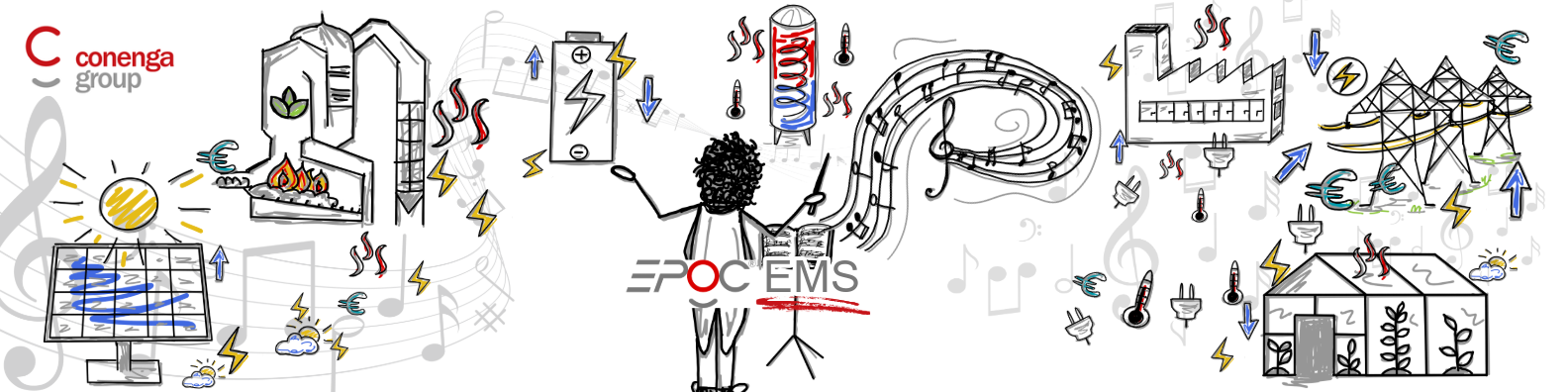
The EPOC® Energy Management System (EMS) optimizes the scheduling and operational planning for the energy facility and handles communication with market operators in the various electricity markets.
Since these markets—such as the day-ahead market, the intraday market, and the balancing energy market—have different auction deadlines, the EMS must submit bids at the correct time. In addition, each market announces its auction results at its own specific times.
However, the optimal driving strategy also depends on which of the submitted bids were accepted—and thus incorporated into the schedule as fixed, unchangeable requirements—and which were not accepted and can therefore still be freely optimized. For this reason, the EMS must not only take market feedback into account during the optimization processes but also actively respond to it. This interplay of necessary interactions between market communication and the phased optimization cycles is summarized as the CONENGA marketing cascade.
How does the marketing process work, and how does the marketing cascade help us?
The simplified market mechanism (auction-based, non-continuous intraday trading) works as follows: Until the market closes, electricity capacity can be bid at a chosen price, such as the levelized cost of electricity. Bids and offers are then aggregated and matched, and bids with excessively high prices are rejected. The actual electricity price is determined according to the merit-order principle and is the price of the most expensive bid that is just enough to meet demand at that price level. Once these calculations are complete, market participants receive feedback on their bids and know how much (and at what price) they can actually buy or sell on the market.
Because EPOC® EMS trades in multiple markets, the marketing cascade is necessary primarily due to the separate auction deadlines of the various electricity markets. Since the feedback for accepted bids is staggered—that is, the timing does not coincide immediately—the cascade allows the EMS to optimize the bids for each market in stages. This ensures that, even if the capacities accepted by the market differ from the bids submitted, the best possible schedule is created. We can examine an example of how the cascade works below.
The Stages of the Marketing Cascade
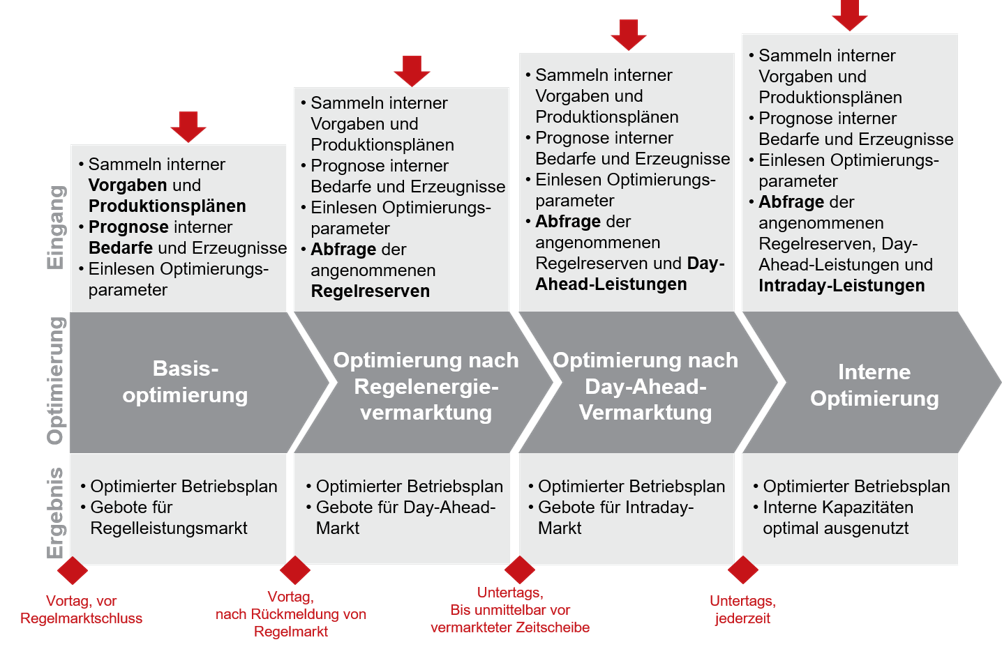
The Stages of the Marketing Cascade
In our example, let’s assume a diversified energy site with combined heat and power generators, a PV system, storage systems, and production facilities serving as heat consumers. The site uses the EMS to sell electricity on the balancing energy market, as well as the day-ahead and intraday markets. So, in this example, how does the EMS navigate the various marketing stages?
Level 0 – Basic Optimization
Initially, in our example, there is no output specified by the market, so the EMS is free to optimize. Prior to this “basic optimization,” necessary data—such as the weather forecast, the production schedule, and an electricity price forecast—is collected to ensure the analysis is based on the most up-to-date information possible. Based on this data, a generation forecast for the PV system and a demand curve for the consumers are generated. Using this data, the EMS creates an optimized operational plan, including the capacities and power outputs to be traded on the markets.
Because the balancing power market has the shortest auction window (9:00, 10:00), the balancing power reserves resulting from this optimization are first bid in this market. After the markets close, feedback is provided on the capacities that were actually accepted, allowing the next optimization run to be carried out:
Stage 1 – Optimization Based on Balancing Energy Trading
In the next stage of the marketing cascade, the awarded balancing capacity is reserved so that it is always kept available. Rejected bids now provide flexibility to be rescheduled and offered on other markets. Thus, during the next run, the optimizer takes into account not only internal load specifications but also the external specifications from the marketing process.
The new, optimized services are offered on the day-ahead market, where the auction deadline is 12:00 p.m. Feedback is provided approximately 1 hour after the market closes and is used again for the next stage:
Stage 2 – Optimization Following Day-Ahead Market Trading
Capacity that was not accepted on the day-ahead market can be offered the next day in intraday trading. The trading procedures here differ from those of previous auction-based markets, as there is no merit order; instead, the “pay-as-bid” principle applies. Otherwise, bids and requests can be submitted for each quarter-hour period up until immediately before that period begins.
Here, the EMS can make new optimizations several times a day—or even every quarter-hour—to market capacity that was rejected on the day-ahead market or that became available at short notice. In this process, marketed capacity is always recorded to guarantee its delivery.
Stage 3 – Internal Optimization
In addition to intraday trading—or even if a facility does not participate in it—optimizations following the marketing rounds may be warranted, for example, due to changed conditions at the site. For example, if one of three heat consumers at our power plant fails, the EMS can take these changes into account in a new optimization and, if capacity is available, schedule the other two units more heavily or reduce heat production. Or if PV output is lower than calculated by the weather forecast due to weather conditions, other systems (generators, storage, consumers) can be scheduled to compensate for the missing output (for example, by reducing the amount of power fed into the battery storage system).
Marketing Cascade in Live Operation
In actual operation, the stages are not traversed linearly, but cyclically and, depending on the market, with a one-day offset: Today’s balancing energy and day-ahead capacity were determined yesterday, while tomorrow’s capacities are bid today and bids for the intraday market are submitted continuously. For this reason, it is essential that the EMS maintains an overview of which services have already been bid and must be delivered, and where there is still available capacity that can be optimized.
Since the optimization process itself takes less than a minute to complete, the EMS can easily handle runs every quarter of an hour.


Dipl.-Ing. Sebastian Voith ist Consultant APC bei der CONENGA Group und beschäftigt sich mit der Entwicklung und Optimierung intelligenter Regelungsstrategien für Energie- und Industrieanlagen. Sein Schwerpunkt liegt auf der Modellierung komplexer Prozesse, adaptiven Regelungsverfahren sowie dem Einsatz von Machine Learning und Edge AI für moderne Advanced-Process-Control-Anwendungen.
Durch sein Studium der Physikalischen Energie- und Messtechnik mit Schwerpunkt Energietechnik verfügt er über fundierte Kenntnisse in der Modellierung und Regelung energietechnischer Systeme. Im Rahmen seiner Diplomarbeit entwickelte er Verfahren zur Modellierung und adaptiven Regelung industrieller Altholz- und Reststoffkessel auf Basis neuronaler Netze.
Expertise
- Advanced Process Control (APC)
- Edge AI und Machine Learning
- Modellierung und Regelung thermischer Energieanlagen
- Adaptive Regelungsverfahren
- Python, C/C++, Matlab und SPS-Programmierung
Fokusbereiche bei CONENGA
- Entwicklung intelligenter Regelungsstrategien
- Einsatz von Edge AI für industrielle Anwendungen
- Modellierung und Analyse thermischer Prozesse
- Advanced Process Control und datenbasierte Optimierung
- Digitalisierung von Energie- und Industrieanlagen