
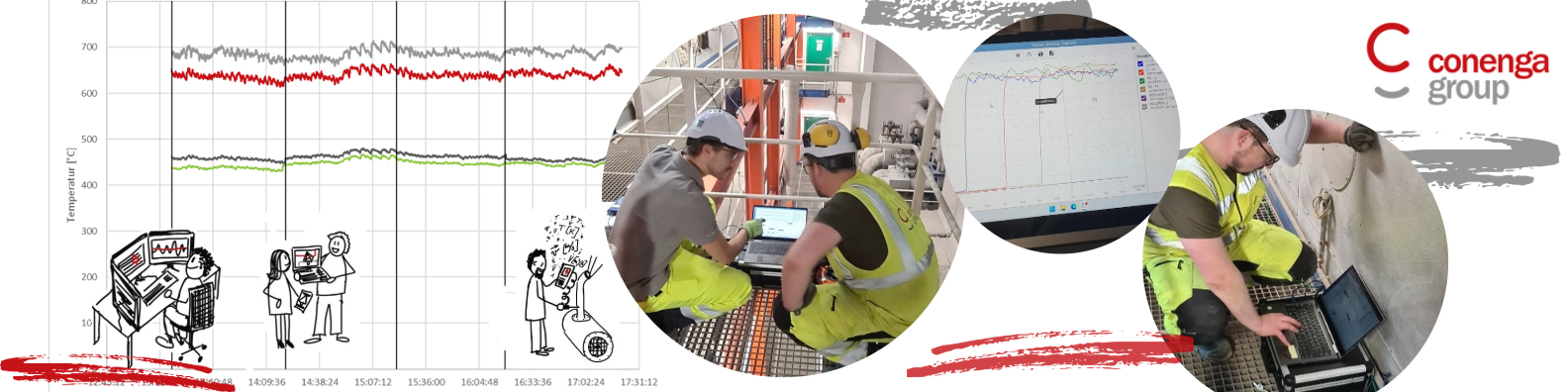

Key Takeaways:
- Accurate measurements provide the basis for informed decisions and cost-effective plant operation.
- Measurement campaigns identify deviations, weaknesses, and previously unrecognized opportunities for optimization during normal operation—without requiring plant downtime.
- The measurement data obtained enables targeted process and control optimizations to increase efficiency and process stability.
- Practical examples show that even small, data-driven adjustments can significantly reduce operating costs and improve profitability.
- Measurement campaigns are suitable, among other things, for verifying existing operational measurements, analyzing temperature distributions, and balancing energy and mass flow rates.
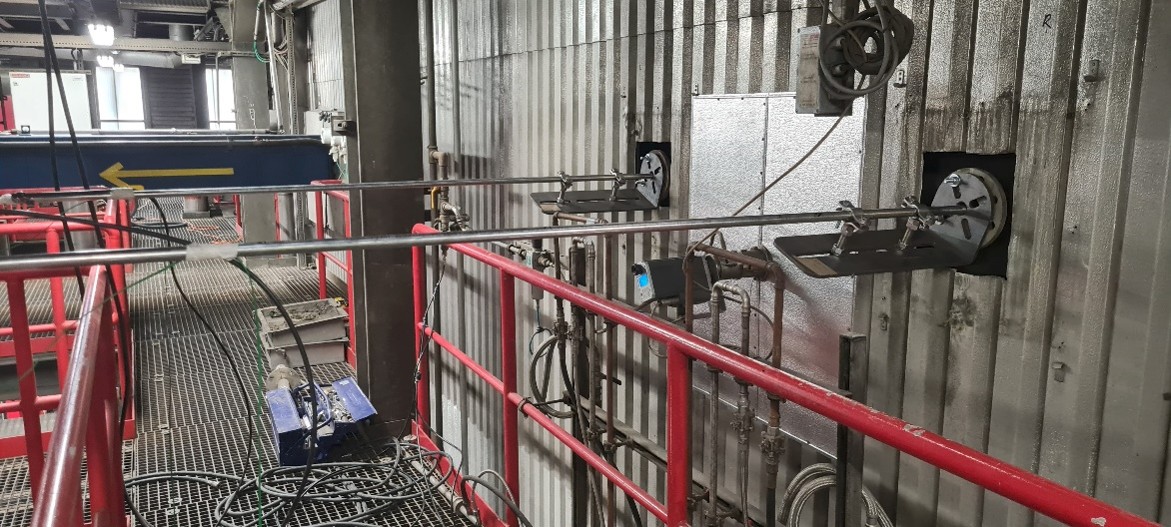
Two parallel temperature measurements using thermocouples
Measuring Correctly
“If you measure, you’re measuring nonsense”—this saying is often heard in technical circles. But we’re turning it on its head:
“If you measure correctly, you lay the foundation for sound decisions.”
In industrial and combustion plants, permanently installed measurement systems form the basis for daily operations. They provide the data used to control processes and monitor plants. However, measurements can be affected by unfavorable installation conditions, contamination, aging, or errors in measurement data conversion. As a result, the plant may not be operating at its optimal point.
A targeted measurement campaign can provide clarity, identify weak points, and uncover opportunities for optimization.
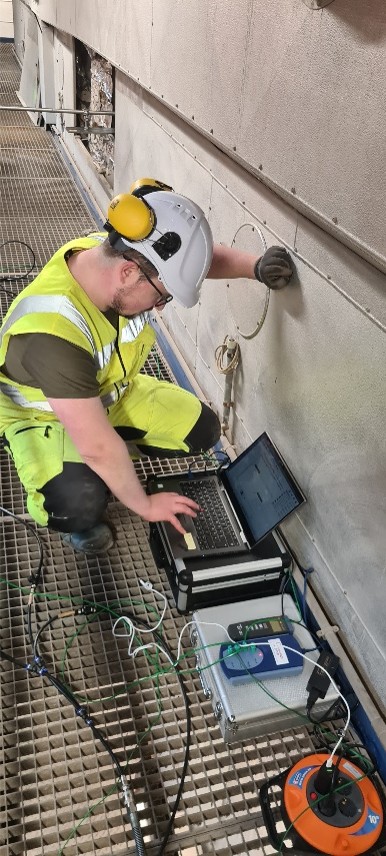
Verification of Correct Data Recording on Site
What is a measurement campaign?
During a measurement campaign, a selected parameter—such as temperature, pressure, fluid velocity, oxygen concentration, or heat transfer—is examined in detail using instruments specifically designed for that purpose. The goal is to obtain as accurate a picture as possible of the actual condition of the plant and to draw conclusions from the results for ongoing operations. The impetus for specific measurements often comes from unexpected data from operational measurements, inconsistent balances, or unexpectedly high consumption of operating materials.
The measurements are carried out by expert personnel from CONENGA Engineers at your thermal plant while it is in operation. Thus, such measurements do not cause any plant downtime and do not result in any additional effort on your part. After the measurement, the collected data is processed and interpreted. It forms the basis for process and control system optimizations. Measurement campaigns are therefore not an end in themselves. Similar to potential studies, they serve to identify specific measures for increasing efficiency, reducing costs, or improving process stability.
Case Study: SNCR System
A real-world example is the measurement of flue gas temperature in the first boiler pass of a thermal incineration plant. The investigation was prompted by an unusually high consumption of ammonia water in the SNCR system for nitrogen oxide reduction.
Our experts suspected that the reactant was being injected outside the optimal temperature range, thereby requiring a higher dosage. To test this hypothesis, a detailed temperature measurement was conducted across the entire cross-section of the boiler pass. Several sensors were used for this purpose, which recorded the absolute temperatures at the respective measurement points.
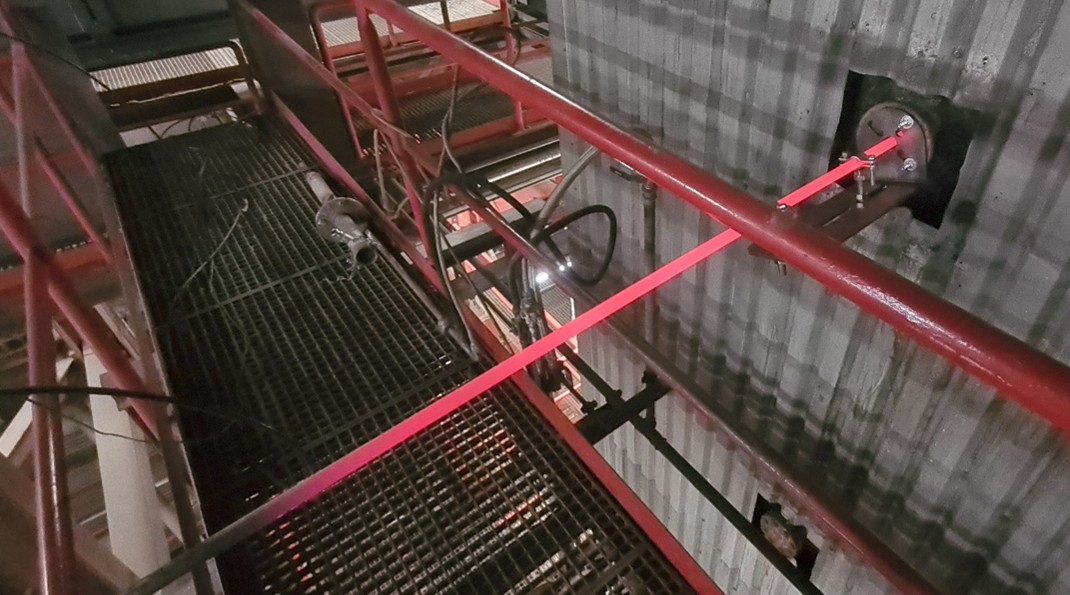
Glowing measuring lance, after taking a temperature reading in the first boiler pass
In addition, it was possible to determine and visualize the spatial temperature distribution within the boiler pass.
The measurements confirmed the hypothesis. It became apparent that the temperature distribution deviated significantly from previous assumptions. Based on the results, targeted and relatively cost-effective adjustments were proposed. This made it possible to sustainably reduce ammonia water consumption and improve the economic efficiency of plant operations.
Conclusion
Measurement campaigns provide a detailed record of the plant’s current status with respect to selected parameters. After the measurements are taken on-site by qualified personnel, the data is analyzed, allowing conclusions to be drawn that lead to more efficient operation of your thermal plant. Thus, such measurements are not an end in themselves, but rather provide the basis for decisions regarding specific measures that will optimize your plant.
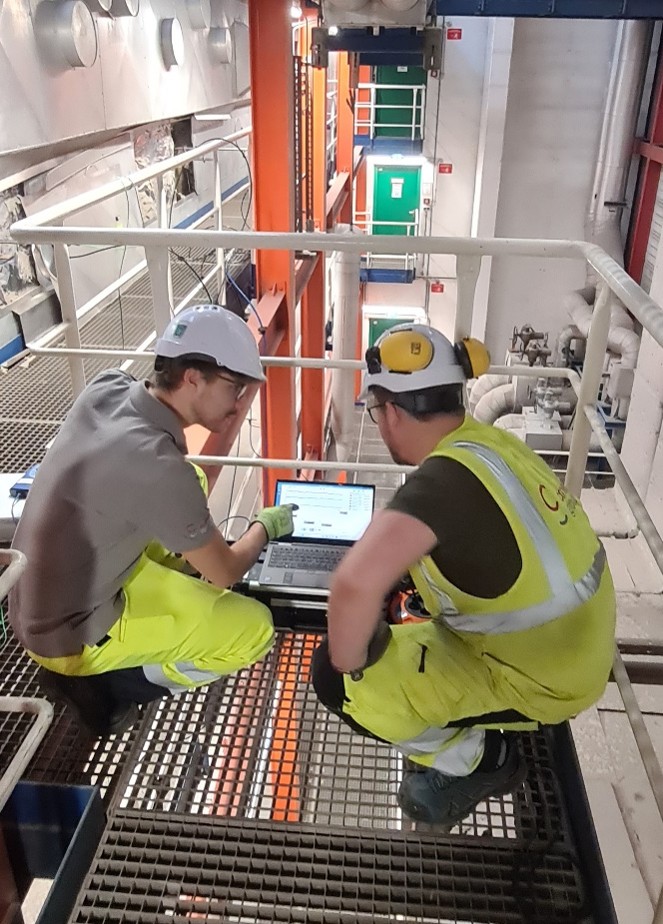
Quick evaluation of measurement data on site
Typical Use Cases for Measurement Campaigns
- Balancing Energy and Mass Flow Equations
- Detection of Temperature Imbalances in Boiler Trains
- Measuring the accurate flue gas temperature for
- Optimal Operating Point of the SNCR System -> Reducing Reagent Consumption
- Preventing Boiler Corrosion -> Extending Service Life
- Optimal Environmental Conditions for Flue Gas Additive -> Additive Savings
- Review of Operational Measurements
- Oxygen concentration
- Flow rate
- Temperature


Jakob Hirsch, BSc ist Process Engineer bei der CONENGA Group und beschäftigt sich mit der Planung und Umsetzung von Optimierungsprojekten, der Durchführung von Potenzialstudien sowie der Konzeption und Begleitung von Messkampagnen für Energie- und Industrieanlagen. Sein Schwerpunkt liegt auf der verfahrenstechnischen Auslegung von Feuerungs- und Rauchgasreinigungsanlagen sowie dem Vergleich unterschiedlicher Anlagentechnologien.
Durch sein Studium der Erneuerbaren Energien sowie sein laufendes Masterstudium im Bereich Regenerative Energiesysteme und technisches Energiemanagement verbindet er fundiertes verfahrenstechnisches Know-how mit aktuellen Entwicklungen im Energiesektor.
Expertise
- Verfahrenstechnische Auslegung von Energieanlagen
Messkampagnen und Anlagenanalyse
Feuerungs- und Rauchgasreinigungsanlagen
Potenzialstudien und Technologievergleiche
Optimierungsprojekte und Servicierungsarbeiten
Erneuerbare Energiesysteme
Fokusbereiche bei CONENGA
- Planung und Umsetzung von Optimierungsprojekten
Konzeption und Durchführung von Messkampagnen
Verfahrenstechnische Analyse von Energieanlagen
Durchführung von Potenzialstudien
Technologievergleiche und Anlagenbewertung