Flue gas cleaning
Flue gas cleaning
Key Takeaways
- Flue gas cleaning reduces pollutants such as dust, HCl, NOx and other emissions and is essential for modern thermal plants.
- Optimized flue gas cleaning not only improves environmental performance, but also reduces operating costs and residual material quantities.
- Modern systems combine process engineering, intelligent control and data-based optimization to ensure compliance with emission limits.
- The CONENGA Group develops tailor-made solutions for flue gas cleaning and optimizes existing systems through analysis, simulation and control technology.
- CONENGA supports projects from analysis and engineering through to implementation and ensures efficient, stable and future-proof system concepts.

Bernhard Kronberger
I am looking forward to answering your questions
Bernhard Kronberger is your expert when it comes to flue gas cleaning!
What is flue gas cleaning?
Flue gas cleaning covers processes for removing pollutants from the exhaust gases of thermal processes and combustion plants. The aim is to reduce emissions such as dust, acids or nitrogen oxides and to comply with legal limits. The CONENGA Group combines process technology, data analysis and intelligent control systems to efficiently optimize existing and new plants.
Our innovative flue gas cleaning solutions offer an effective and sustainable way to minimize the use of operating materials such as lime additives or activated coke in your plants. Through our customized approaches, we can increase the efficiency of your plant while simultaneously reducing the volume of costly residual materials, such as filter ash, that must be disposed of.
Our expertise in flue gas cleaning enables us to develop customized solutions for your facility. We place particular emphasis on close collaboration with our customers to achieve the best possible results. We are here to support you as your partner—from the initial analysis through the development of a customized concept to implementation and optimization.
Whether optimizing existing systems or developing completely new solutions – we have the experience and know-how to meet your requirements.
Our services at a glance:
- Analysis of the status: examination of the system and emission limit values
- Data analysis: evaluation and interpretation of relevant data
- Concept development: Development of customized solutions
Example of a sorption process
Our example plant consists of two combustion lines, a common storage tank for the absorbent Ca(OH)2 and a common HCl measurement at the stack. The aim in this example is not to exceed the legal requirement of 10 mg/m³ HCl in the flue gas while at the same time minimizing the total lime input.
We achieve this goal by using advanced model equations for HCl adsorption, which are mapped in a special control algorithm. This algorithm calculates the loading (in g-HCl per g-lime) based on the HCl concentration in the flue gas. Our system takes into account all process-related influencing factors in order to maximize lime adsorption.
In this way, we keep the total amount of lime used and the disposal costs as low as possible.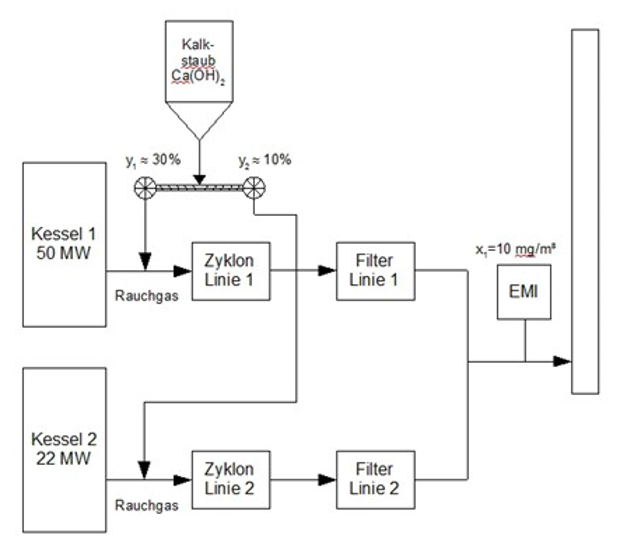
Dedusting
Dedusting is an essential part of flue gas cleaning in waste wood and waste incineration plants as well as in industrial dedusting. We have extensive expertise in the design, control and optimization of these systems.
Our goals include minimizing operating costs and maximizing travel times for key technologies such as fabric filters or multi-cyclones. By optimizing these plants, clean exhaust air and thus optimal environmental protection is achieved.
For the dedusting of combustion exhaust gases, it can make sense to optimize the degree of dust separation instead of minimizing it in order to improve the residual material disposal routes. The purity of the exhaust gases always remains the top priority.
Methods used
- Mass and energy balancing: determination of energy and material flows
- Comparison of key figures: benchmarking and performance analysis
- CFD analysis (Computational Fluid Dynamics) as a basis for flow optimization ( together with scientific cooperation partners)
Optimization measures
- Conception, basic and detail engineering of conversion measures
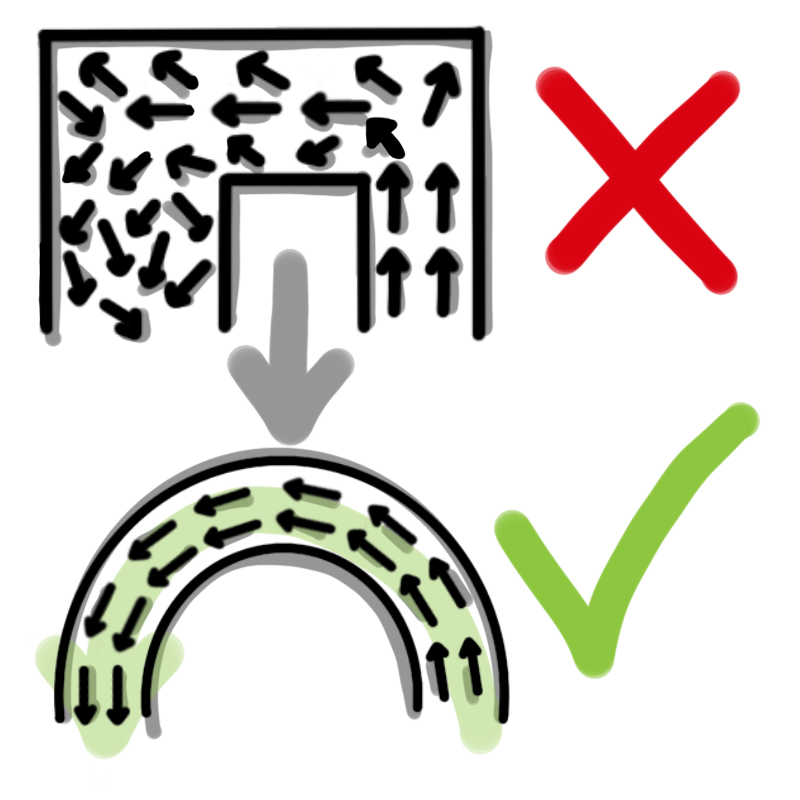
- Cyclone design based on the laws of fluid mechanics
- Use of baffles and flow equalizers to improve flow control
- Support in selecting the optimum filter media
Further information:
Further information:

FAQ on flue gas cleaning

Unsere Kunden