

Key Takeaways:
- Optimizing individual systems is not enough. The key factor is the interaction between producers, consumers, storage facilities, and production processes.
- A modern energy management system (EMS) looks beyond the individual facility. It combines operational data, forecasts, technical capabilities, and energy markets to provide a comprehensive overview.
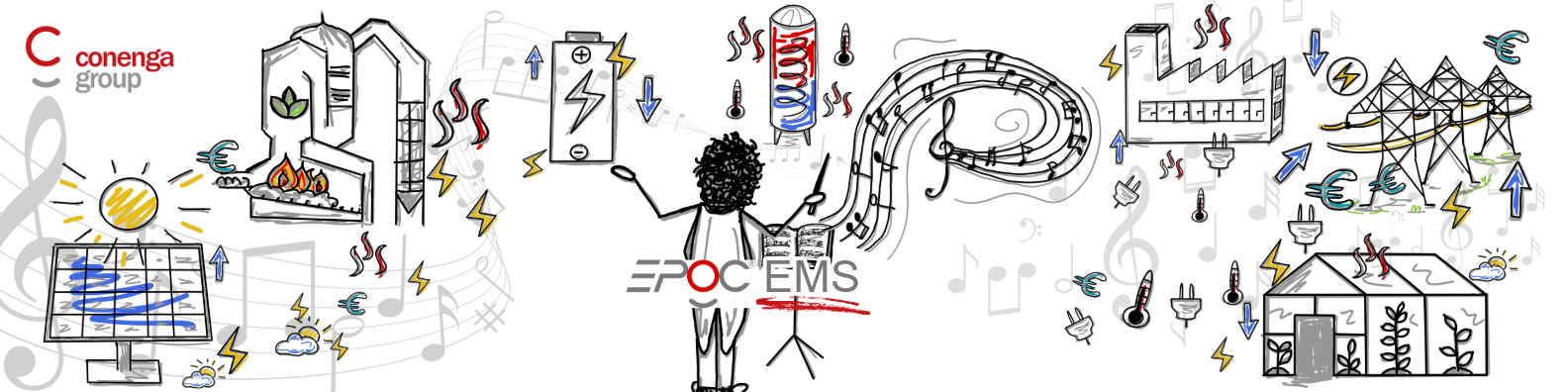
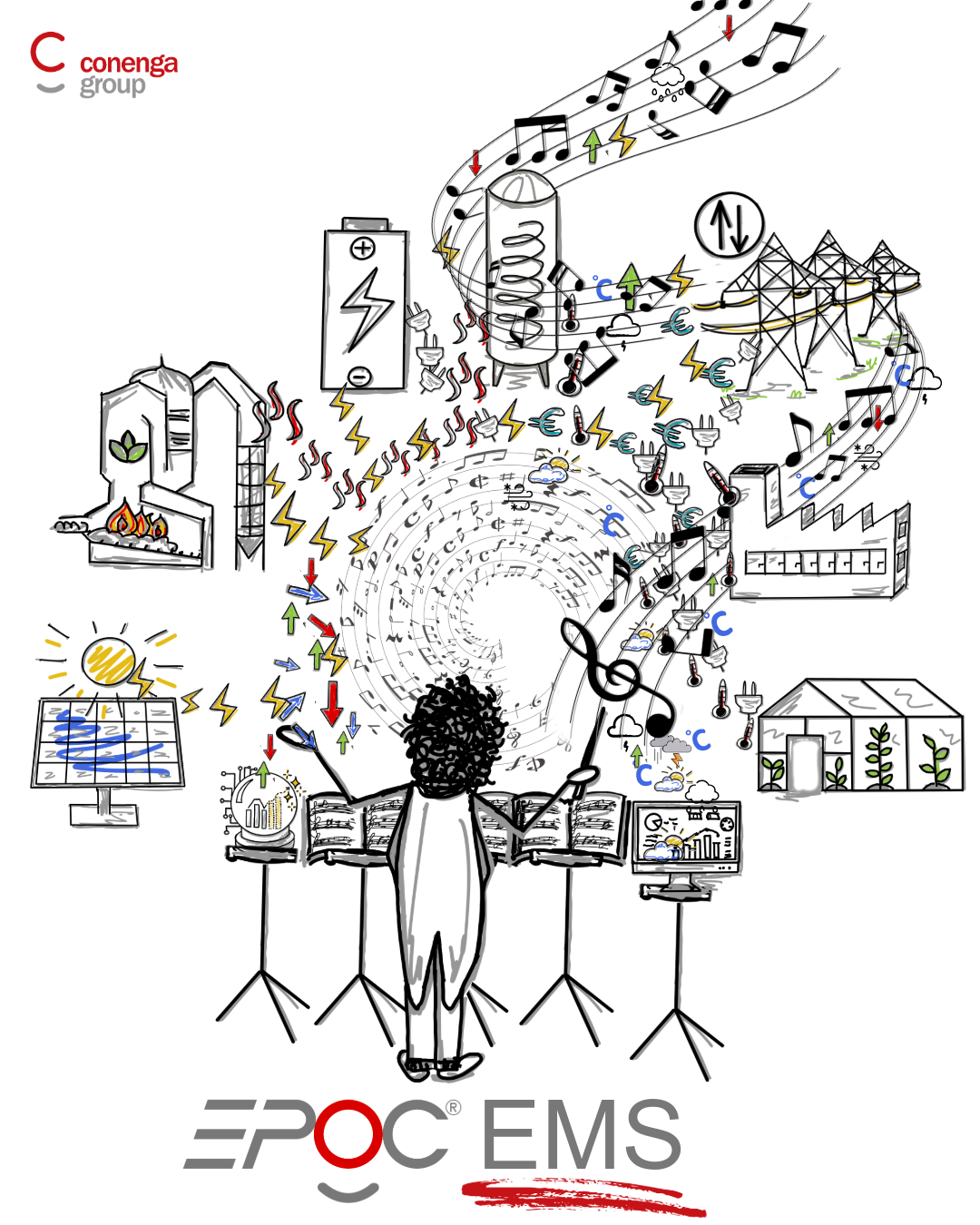
- EPOC® EMS acts as the conductor. It coordinates the interaction of the individual systems and develops optimized schedules to create a cohesive overall concept.
- Flexibility is becoming an economic factor. It is not just the amount of energy required that matters, but also when and how flexibly it can be used.
- Automation requires control.EPOC® EMS supports and optimizes plant operations, but leaves operational control and the ability to intervene in the hands of the operator.
EPOC® EMS as the Conductor—When the Energy System Becomes an Orchestra
In an industrial plant, many systems operate simultaneously: steam generators, dryers, consumers, storage tanks, electrical systems, and production facilities. Fluctuating energy prices, varying operating conditions, and—increasingly—the ability to trade energy flexibly on the market further add to the complexity.
Each of these systems has its own function. The real challenge arises when they are connected to one another.
I like to compare it to an orchestra.
An orchestra consists of many individual instruments. Each one can function on its own. However, what is crucial for the ensemble’s performance is not just that each musician has mastered their instrument. What is crucial is that everyone plays together at the right moment.
This is exactly where the role of a modern energy management system comes into play.
Many systems, one integrated system
Industrial energy supply is rarely a static system. Loads fluctuate, production processes ramp up or down, energy prices fluctuate, and availability changes. Therefore, those who optimize individual systems in isolation can only capture a fraction of the significant potential. A steam generator can be operated efficiently. A dryer can optimize its energy consumption. A steam system can respond to different operating conditions. An energy storage system can be deployed strategically.
But what happens when these systems are considered together?
Then it’s no longer about optimizing individual instruments. It’s about the interplay of the entire orchestra.
The conductor isn’t just familiar with the instruments
A good conductor doesn’t play every instrument himself. He must understand what each instrument is capable of, how the individual parts fit together, and when it makes sense to bring each one in.
I see the role of an energy management system in a similar light.
It does not take over the functions of the existing control system. Rather, it creates a higher-level framework within which energy generation, energy consumption, and production requirements can be considered together. To achieve this, the interrelationships must first be understood. Which consumers are interdependent? Which systems can be operated flexibly? Where are the technical limitations? Which operating states make sense? And what impact does a change in one area have on the overall system?
That can’t be answered with simple if-then logic.
Data Becomes a Schedule
A modern energy management system must therefore do more than simply measure energy consumption and display the data on a dashboard. It must be able to use operational data, forecasts, and market information to determine how a facility can be operated effectively.
With EPOC® EMS, this is achieved through customized mathematical modeling of each specific location. The existing facilities and their interrelationships are not viewed as isolated units, but rather as parts of an overall system. Automated schedules can be generated on this basis. This process incorporates various current and forecasted values, such as operational statuses, energy prices, and weather data. Different energy markets can also be taken into account—from day-ahead and intraday trading to balancing energy.
So the conductor doesn’t just know the orchestra. He also knows what might happen in the next hour or the next day.
The beat doesn’t always come from the conductor
One important point to note is that an energy management system should not replace the existing plant control system. Operational control remains where it belongs.EPOC® EMS provides setpoints and optimization parameters that can be transferred to the existing control system. At the same time, the plant operator must always have the option to override these parameters or deactivate the optimization function.
In my view, that is crucial.
After all, even the best conductor cannot anticipate every situation. An industrial plant must be able to respond to real-world events: changes in production, technical constraints, or unplanned conditions. Automation therefore always requires clear options for intervention.
Not every orchestra plays the same music
Just because something works at one site doesn’t mean it makes sense at another. An industrial facility with high steam demand has different requirements than a site with large electrical loads or flexible thermal processes. That’s why I think standardized solutions make sense at the software level—but not for modeling the specific site.
EPOC® EMS has a modular design. For recurring blocks and systems, there are pre-built modules that can be individually assembled and adapted. The EMS can also be combined with other optimization solutions within theEPOC® Suite. The basic principle remains the same: the focus is not on a single facility, but on the interaction of the entire energy system.
Energy thus becomes a controllable variable
The discussion about energy in industry often revolves around efficiency. That’s true, but it’s increasingly falling short. The crucial question isn’t just: How much energy does a plant consume?
But also:
- When is the energy needed?
- What options are available?
- Which form of energy makes sense at which point in time?
- And what is the market value of this flexibility?
This also changes the role of energy management. It is increasingly evolving from a system that monitors consumption and provides key metrics into one that actively intervenes in the planning and optimization of plant operations. The conductor does not ensure that every instrument plays as loudly as possible. Instead, he ensures that the orchestra as a whole sounds good.
To me, that is precisely what the real purpose of an EMS is
An energy management system should not be just another system that collects data. It should identify correlations, integrate different types of information, and use that information to make concrete operational decisions.
EPOC® EMS is therefore not about adding another dashboard, but rather about the overarching optimization of an industrial energy system. The individual systems remain the tools. The existing control system remains responsible for actual operations.
AndEPOC® EMS takes on the role of the conductor: It brings technical capabilities, operational requirements, forecasts, and energy markets into sync. After all, as industrial energy systems become more complex, it is not only the quality of the individual components that becomes more important, but also the quality of their interaction.

Dipl.-Ing. Richard Wipp ist Geschäftsführer und CEO der CONENGA Group und verantwortet seit 2020 den Aufbau, die operative Führung und die technische Entwicklung des Unternehmens. Sein Schwerpunkt liegt auf der Optimierung, Regelung und Digitalisierung von Energieanlagen, insbesondere Biomassekraftwerken, Reststoffverbrennungsanlagen und Fernwärmesystemen.
Mit über 20 Jahren Erfahrung im Engineering und in der praktischen Umsetzung komplexer Industrieprojekte verfügt er über umfassende Expertise in der Entwicklung und Implementierung innovativer Regelungs- und Optimierungslösungen für thermische Energieanlagen. Bereits 2007 gründete er die VOIGT+WIPP Engineers GmbH (heute CONENGA Engineers GmbH) und verantwortete als Geschäftsführer den operativen Aufbau und die technische Entwicklung des Engineering-Büros. 2013 folgte die Gründung der VOIGT+WIPP Energy & Environment GmbH (heute CONENGA Energy & Environment GmbH), die sich auf innovative Lösungen zur Effizienzsteigerung und Emissionsreduktion konzentriert.
Richard Wipp studierte Maschinenbau an der Technischen Universität Wien sowie an der Universidad Politécnica de Valencia in Spanien und verfügt über eine fundierte technische Ausbildung mit Schwerpunkt auf thermischen Prozessen und Energieanlagen.
Im Rahmen seiner Tätigkeit bei CONENGA verantwortet Dipl.-Ing. Wipp zahlreiche nationale und internationale Optimierungsprojekte für Verbrennungs- und Industrieanlagen, darunter KI-basierte Regelungssysteme, modellprädiktive Regelung (MPC), Emissionsoptimierung und Effizienzsteigerung komplexer Energieanlagen. Seine Arbeiten wurden unter anderem im Rahmen internationaler Fachveranstaltungen, Forschungsprojekte und Fachkreise im Bereich Wirbelschichttechnologie, Fernwärmesysteme und Anlagenoptimierung präsentiert.
Expertise
- Optimierung und Regelung thermischer Energieanlagen
- Biomassekraftwerke und Reststoffverbrennungsanlagen
- Advanced Process Control (APC) und modellprädiktive Regelung (MPC)
- Emissionsoptimierung und Effizienzsteigerung
- Digitalisierung und datenbasierte Prozessoptimierung
- Engineering und Implementierung komplexer Energieanlagen
Fokusbereiche bei CONENGA
- Optimierung von Biomasse- und Industrieanlagen
- Entwicklung und Implementierung intelligenter Regelungssysteme
- Emissionsreduktion und Effizienzsteigerung
- Digitalisierung und Advanced Process Control
- Engineering und technische Leitung von Optimierungsprojekten