Dryer systems
Dryer systems
Key Takeaways
- Drying systems require a coordinated combination of process engineering, control technology and energy balancing in order to ensure product quality, energy efficiency and process stability at the same time.
- The CONENGA Group optimizes dryer systems by combining process and control strategies to reduce energy consumption, emissions and unstable operating conditions.
- Using model-based control, data analysis and soft sensors, fluctuations in material moisture, temperature and throughput can be detected at an early stage and automatically compensated for.
- Modern drying processes use recirculation, load forecasts, heat recovery and dynamic control algorithms to minimize specific drying energy and stabilize exhaust air conditions.
- The CONENGA Group integrates simulations, plant balancing and APC solutions into existing industrial plants to enable stable production conditions and low-emission operating modes.

D. Gappmaier& B. Kronberger
We are looking forward to answering your questions
Dominik Gappmaier & Bernhard Kronberger are your experts when it comes to drying systems!
We are familiar with a wide range of process engineering challenges for different types of dryers and in specific industries. You benefit from this wealth of experience in combined process and control engineering optimization. The customized control concept gets the maximum out of your dryer systems, usually leading to smoother and therefore more robust operation with consistently high energy efficiency, quality and performance of the drying process.
Your advantages at a glance
- High energy efficiency, corresponding economic efficiency
- Quiet, robust operation
- Constant product quality
- Emissions within the limit values
- High degree of automation
- Transparent KPIs
Our extensive experience from many implemented projects is integrated into our EPOC Dryer product.
Would you like to find out more? Should we call you or would you like to receive further information by e-mail?
The CONENGA Group combines process engineering, simulation, advanced process control and data analysis for the energy-efficient and low-emission optimization of industrial dryer systems.

Dryer-specific design levers
Indirectly heated drum dryers
-
- Shortening
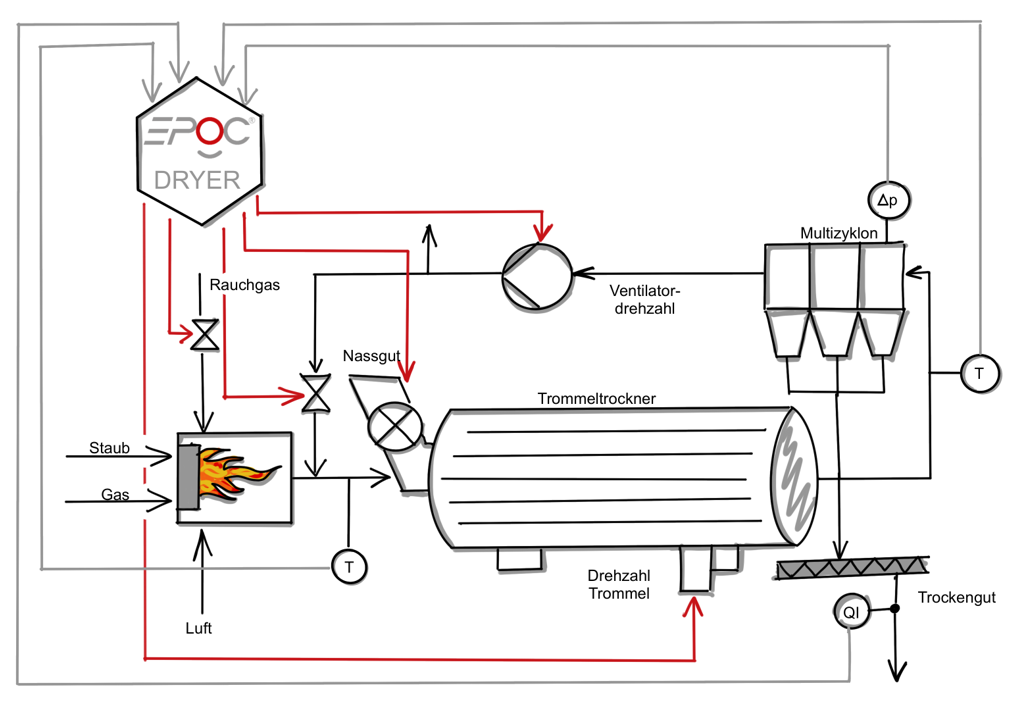 the start-up times of a dryer after standstill (rapid achievement of a stable operating state, e.g. for chip feeding)
 - Stable discharge of condensate from the tube bundles
- Good material transport in the drying drum
- Optimum drying air recirculation with centre extraction
- Automatic optimization (minimization) of specific energy consumption for chip drying
- Avoidance of oscillations of the exhaust air temperature
- Avoidance of chip supply shutdowns due to “dryer clogging
- Shortening
Directly heated drum dryers
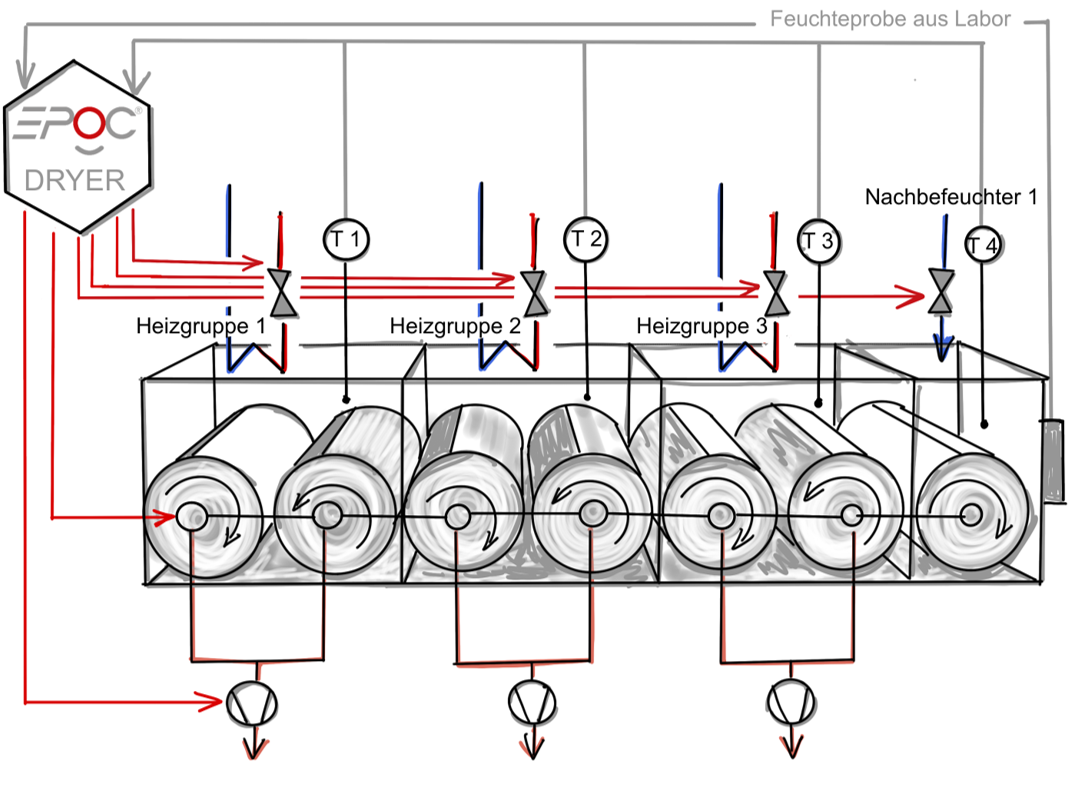
-
- Optimum process control with and without exhaust air recirculation for energy-efficient operation through optimum saturation of the drying gas
- Optimum loading and temperature of the extract air, taking into account the humidity balance (sorption isotherms)
- Good material transport in the drum
Trough-air drying (screen drum and belt dryers)
-
- Minimization of the specific drying energy requirement
- Optimum throughput
- Minimization of start-up times
- Minimization of rejects during start-up and in the event of malfunctions
Airstream dryer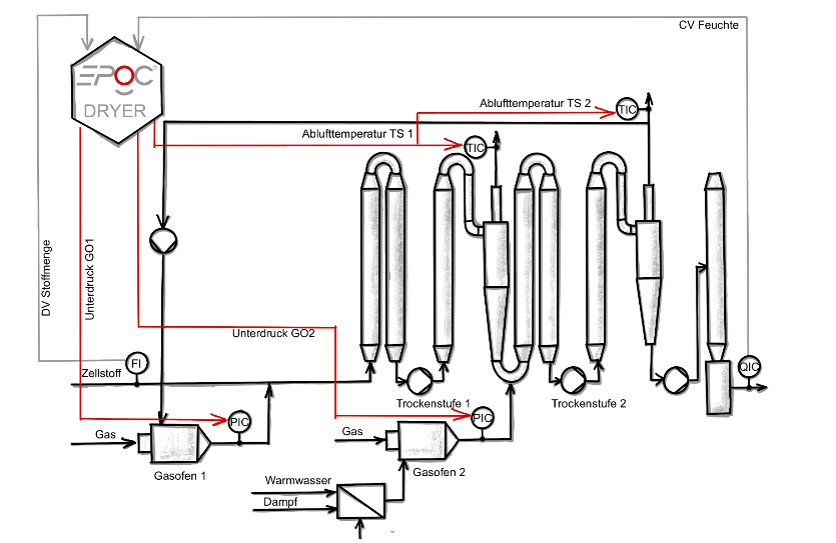
-
- Optimum energy distribution with 2-stage drying
- Maximum recirculation of drying air by regulating the negative pressure
- Regulation of exhaust air temperatures, thus optimum saturation of the drying air
Dryers of paper and coating machines
-
- Fast automatic ramp-up after tear-off and standstill from performance speed to maximum target speed – especially for “light” products (low grammage)
- Maximizing the target speed while maintaining the highest product quality, especially for “heavy” products (high
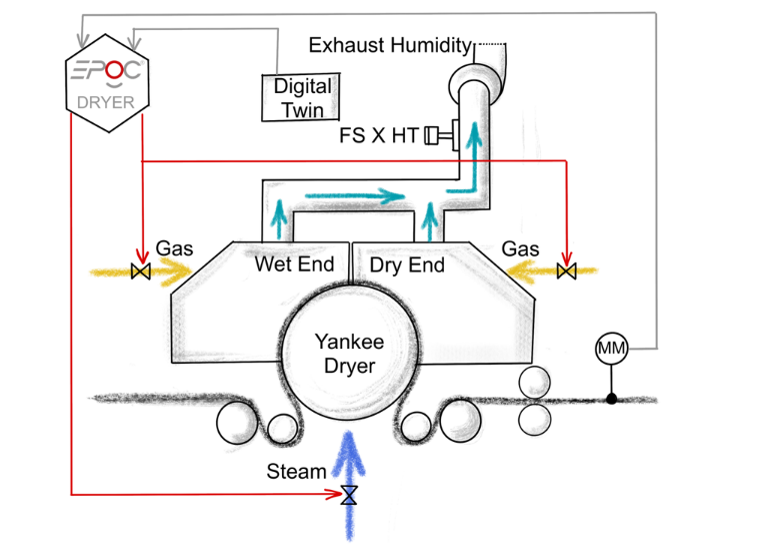 grammage)
 - Minimization of grammage change waste by accelerating grammage changes
- Automatic provision of optimized tear-off/feed cylinder parameters
- Maximum quality with high energy efficiency
- Automatic detection and visualization of the maximum speed, taking into account the condition of the line
- Visualization of limiting factors
Depending on the technology, we use the basic levers mentioned above in our combined process and control optimization.
Further links & information:
Further links & information:

FAQ about dryer systems
Unsere Kunden