


Key Takeaways:
- Digitalization lays the foundation for informed decisions by consolidating operational data from various sources and making it transparent.
- Data only reveals its value through integration, analysis, and interpretation —it forms the basis for feasibility studies, optimization efforts, and AI-powered applications.
- CONENGA Process Data collects data from multiple manufacturers, standardizes it, and makes it available for analysis and visualization.
- Digital energy management enables automated optimization by combining operational, weather, and market data to create optimal schedules.
- Digitalization combines economic efficiency with sustainability by increasing efficiency, reducing CO₂ emissions, and preparing companies for future challenges.
What does digitalization mean in the industrial sector, and what added value does it offer?
To make sound decisions, data is needed as a foundation—regardless of whether the decisions are made solely by humans or with the support of AI-based systems. For people, data-driven decisions primarily mean fact-based decisions—that is, decisions based on verifiable information rather than gut feelings. And for any AI model, data is the indispensable foundation of every analysis and every forecast.
Whether it’s a person or a machine—without reliable data, every decision remains a guessing game. That’s why we at the CONENGA Group place a high value on a data-driven approach in our potential studies and, when necessary, conduct targeted measurement campaigns to provide the data needed for decision-making in a complete and error-free manner. As my colleagues Ralf Ohnmacht and Bernhard Klug demonstrate in their blog posts on potential studies and data analysis, hard technical data is not the only basis for these studies—and its correct interpretation by humans remains a key factor. However, this data—especially operational data—is always an essential pillar of the analysis and thus a cornerstone for developing well-founded recommendations for improvement.
But what should you do if this operational data isn’t available yet—if it’s scattered across different systems, incomplete, or simply inaccessible? There’s a solution for that, too. Before we get to that, it’s worth taking an objective look at digitalization in industry and its significance, particularly in the energy sector and for energy-intensive production.
Where the Industry Stands Today
More than 10 years ago, the term “Industry 4.0” was used to describe an industrial revolution in which companies connect their machines, warehousing systems, and equipment worldwide so that they can exchange information autonomously and control one another —as described in the 2013 implementation recommendations for the “Industry 4.0” future project by the German Academy of Science and Engineering. According to a representative survey on Industry 4.0 conducted by Bitkom in 2026 among 555 German industrial companies with more than 100 employees, 94% of companies consider Industry 4.0 important for remaining competitive on the global stage. At the same time, when it comes to one of the most widespread Industry 4.0 applications—the digital twin—over 60% of companies already feel they are falling behind.
In our projects, we see that even smaller companies face similar challenges. For example, while data is often already collected digitally in practice, there is still a significant need to catch up in terms of connectivity in some cases. It is not uncommon for data to be copied manually into Excel spreadsheets and compared by hand. The discussion has now moved beyond Industry 4.0: Under the banner of Industry 5.0, the European Commission, among others, is once again placing greater emphasis on people and complementing technological connectivity with a vision of a sustainable, resilient, and people-centered industry.
Industry 5.0 is not intended as a contrast to Industry 4.0, but rather as its further development—data connectivity remains the foundation, yet the role of humans as decision-makers and the goal of a society worth living in are gaining greater importance. We are often still a long way from achieving automated data connectivity across an entire site—spanning all relevant systems from different manufacturers—let alone global connectivity. But why is this site-wide connectivity so important?
Why Digitalization Is Important
The benefits of digitalization do not stem from the technology itself, but from the decisions it enables. It is helpful to view this as a step-by-step model. The first step is pure data collection—that is, measuring and storing operational metrics. This is followed by networking and transparency, in which data from various sources is consolidated and correlations are made visible.
The next stage adds analysis and forecasting, such as recognizing patterns or predicting conditions.
The final stage is optimization and automation, in which concrete decisions and interventions are derived from insights. These can range from long-term measures, such as renovations, to the continuous creation of optimal schedules. The path from a single data point to a reliable insight is therefore not a given, but rather a multi-stage process.
One of the primary goals of digitalization is to create transparency. By collecting and linking data, operational conditions, anomalies, and interrelationships become visible that might otherwise remain hidden during normal operations. Those who understand these correlations can identify and leverage potential opportunities to increase efficiency—thereby achieving both economic and environmental benefits. Furthermore, digitalization improves predictive capabilities. For example, predictive maintenance allows for the early detection of impending failures before they lead to unplanned downtime.
The digital twin takes this a step further—it is a representation of a real plant that is continuously updated with operational data. It allows users to analyze conditions and evaluate scenarios without interfering with ongoing operations. In this way, the mere observation of operations becomes a reliable basis for forward-looking decisions.
These capabilities are particularly significant in the energy sector and in energy-intensive manufacturing facilities. Here, precise load and generation forecasts can be used to derive optimized schedules that not only lower costs but also specifically reduce CO₂ emissions, thereby contributing to decarbonization and the energy transition.
In its 2017 report *Digitalization and Energy*, the IEA describes digitalization as one of the key prerequisites for a more efficient and flexible energy system, and in its 2025 report *Energy and AI*, it again highlights the digitalization of historical and current operational data as a fundamental requirement. Added to this are system integration and sector coupling, which are becoming increasingly important due to the growing share of volatile (renewable) generation. The EU also highlights this in its Action Plan on the Digitalization of the Energy System, in which access to energy-related data is described as “an essential prerequisite for a digitalized energy system.” And what applies on the large scale of a “common European energy data space” begins at the company or site level.
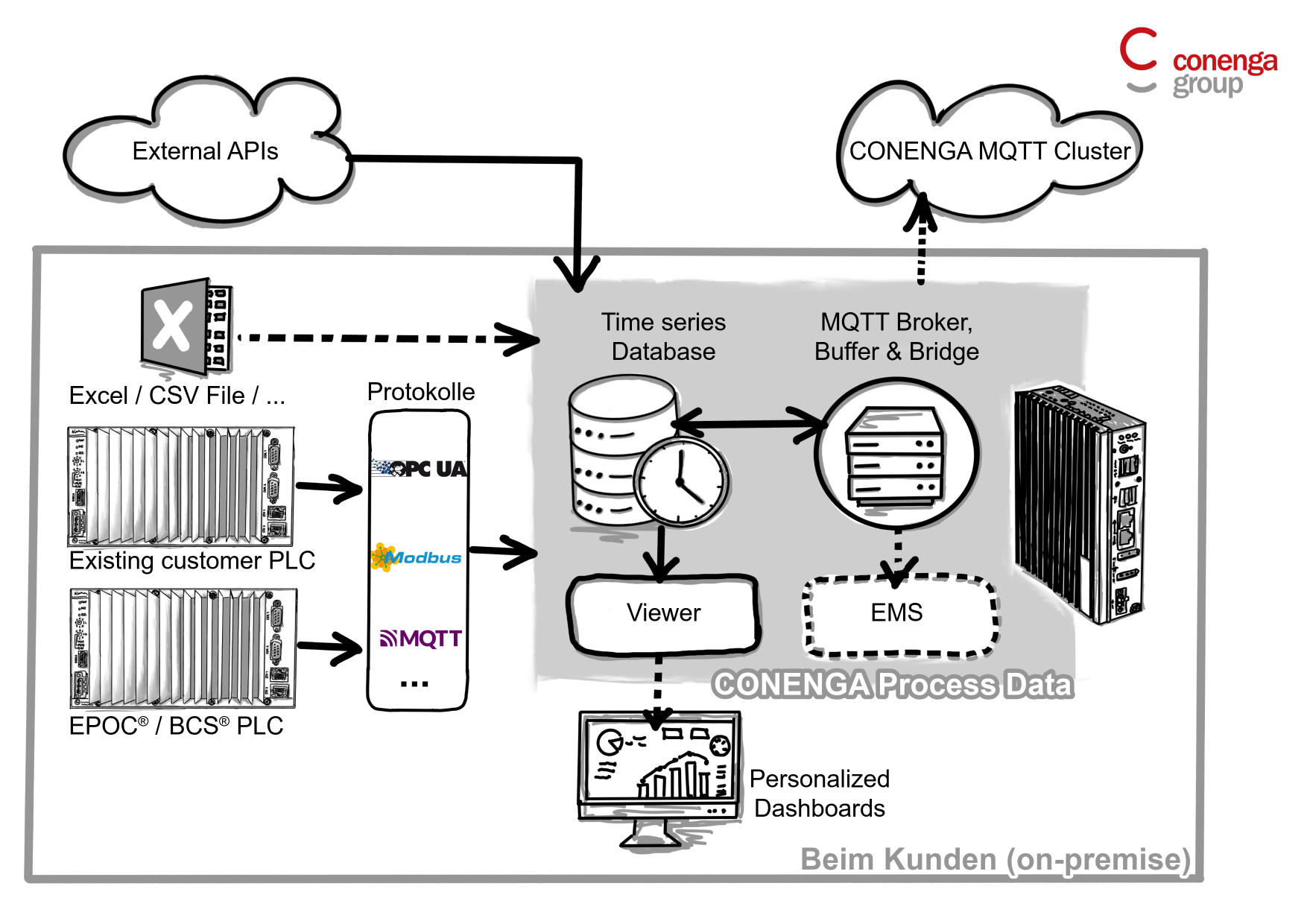
However, one major hurdle remains: In practice, data is often scattered across different systems, formats, and silos. Its value only becomes apparent once it is consolidated and placed within a shared context. This brings us full circle: Digitalization generates data, but this data must be consolidated, validated, and interpreted before it can be used to make sound decisions. This is exactly where the CONENGA Group comes in. To turn distributed data into a reliable basis for decision-making, we consolidate data from various sources—across different vendors—into a single database, visualize the relationships, and, when needed, generate data-driven analyses and reports.
 From Distributed Data to a Basis for Decision-Making
Data Collection & Networking
Our solution is based on CONENGA Process Data, which we developed in-house and which provides the necessary integration. Here, data from various systems, plants, and formats is collected and consolidated. It is a flexible solution capable of handling a wide variety of data sources and protocols. This allows data to be integrated via OPC UA, Modbus, MQTT, and other protocols. If necessary, data can also be collected via a dedicated PLC or imported into the system from Excel spreadsheets—the latter method is particularly useful for integrating historical data. Furthermore, external data—such as weather data or data from electricity price exchanges—can be integrated via the appropriate APIs.
Transparency
The data is then initially stored in a database on-site. This ensures that the customer retains control over the data and prevents vendor lock-in. Of course, CONENGA also offers a viewer for the data as an extension of CONENGA Process Data. Using this human interface, the data is customized for each customer location and made accessible to the people on the shop floor—in a way that is understandable, transparent, and decision-oriented. After all, data only realizes its full value when the right people can draw the right conclusions from it at the right time.
Analysis
With CONENGA Process Data, we also offer the option to store data on CONENGA’s own servers. The data is securely transmitted and stored and can then be easily used as the basis for the analyses and potential studies mentioned earlier. Thus, we offer “a European cloud solution with real added value.”
Optimization and Automation
We also offer various products in which data serves as the basis for automated decisions. For example, for our energy management system (EPOC® Energy Management System (EMS)), we first consolidate the relevant data in CONENGA Process Data. This process takes into account both thermal and electrical energy generators (converters), storage systems, and consumers.
The optimization process then incorporates technical specifications, operational data, and external data such as weather and price data. Depending on the requirements, AI-supported and physically modeled forecasting models are used to calculate, for example, load forecasts for consumers and predictions for volatile energy sources such as wind and solar. Ultimately, the EMS automatically calculates the optimal schedules for the entire site based on the collected data. This not only reduces the facility’s own costs—for example, by increasing the self-consumption rate—but may also open up entirely new marketing opportunities through the active optimization of energy generation based on day-ahead prices or participation in the balancing energy market. In this way, the EMS enables what was formulated in the implementation recommendations for the Industry 4.0 initiative: “Production is transparent throughout the entire process and enables optimal decisions. Industry 4.0 gives rise to new forms of value creation and innovative business models.” And it goes even further: In the spirit of Industry 5.0, additional criteria such as CO₂ reduction and grid stability can be taken into account during optimization. In this way, the EMS combines economic efficiency with sustainability and resilience, not only creating social value but also enabling flexible adaptation to future changes in framework conditions.
This paves the way from individual data points to well-informed decisions—serving as the foundation for potential studies, data-driven optimization, and the use of AI-supported analyses.
Sources
• acatech / Kagermann, H., Wahlster, W., Helbig, J. (2013): Implementation Recommendations for the Industry 4.0 Future Project. Final Report of the Industry 4.0 Working Group. — https://www.acatech.de/publikation/umsetzungsempfehlungen-fuer-das-zukunftsprojekt-industrie-4-0-abschlussbericht-des-arbeitskreisesindustrie-4-0/
• Bitkom (2026): Industry 4.0 – How Digital Is Germany’s Industry? — https://www.bitkom.org/Bitkom/Publikationen/Industrie-40-Wie-digital-ist-Deutschlands-Industrie
• Tao, F. et al. (2019): Digital Twin in Industry: State-of-the-Art. IEEE Transactions on Industrial Informatics 15(4), 2405–2415. —https://doi.org/10.1109/TII.2018.2873186
• IEA (2017): Digitalization and Energy. International Energy Agency, Paris. — https://www.iea.org/reports/digitalisation-and-energy
• IEA (2025): Energy and AI. International Energy Agency, Paris. — https://www.iea.org/reports/energy-and-ai
• European Commission (2022): Digitalization of the Energy System – EU Action Plan (COM(2022) 552). — https://eur-lex.europa.eu/legal-content/DE/TXT/HTML/?uri=CELEX:52022DC0552
• European Commission (2021): Industry 5.0 – Toward a sustainable, human-centric, and resilient European industry. — https://research-and-innovation.ec.europa.eu/news/all-research-and-innovation-news/industry-50-towards-more-sustainable-resilient-and-human-centric-industry-2021-01-07_en

Dr. techn. Thomas König ist Senior Digitalization Expert bei der CONENGA Group und beschäftigt sich mit der Digitalisierung und datenbasierten Optimierung in der Prozessindustrie. Sein Schwerpunkt liegt auf der Entwicklung physikbasierter Modelle, Simulationsverfahren und intelligenter Algorithmen zur Analyse und Optimierung komplexer technischer Prozesse.
Mit mehr als 15 Jahren Erfahrung in den Bereichen Modellierung, Simulation, Regelungstechnik und Softwareentwicklung verbindet er wissenschaftliche Expertise mit praxisnahen Digitalisierungslösungen. Thomas König promovierte an der Technischen Universität Wien im Bereich Automatisierungs- und Regelungstechnik und entwickelt innovative Verfahren zur datengetriebenen Prozessoptimierung sowie KI-gestützte Lösungen für industrielle Anwendungen.
Expertise
Digitalisierung von Industrie- und Energieanlagen
Physikalische Modellierung und Simulation
KI-gestützte Prozessoptimierung und Data Science
Advanced Process Control (APC)
Regelungstechnik und Algorithmenentwicklung
Python und wissenschaftliches Computing
Fokusbereiche bei CONENGA
Digitalisierung industrieller Prozesse
Entwicklung intelligenter Optimierungsalgorithmen
Modellbasierte Prozessanalyse und Simulation
Advanced Process Control und Künstliche Intelligenz
Digitale Zwillinge und datenbasierte Engineering-Lösungen