 Ritten district heating plant – potential study & implementation of BCS suite
Ritten district heating plant – potential study & implementation of BCS suitePotential study instead of major investment – tapping into hidden reserves
Thanks to the combination of sound analysis and intelligent control, the growth of the district heating network could be fully managed with the existing infrastructure – economically, climate-friendly and without additional boiler investments.
The challenge
- Continuous annual growth in connected load in the district heating network
- Avoidance of fossil peak load (oil) for climate and cost reasons
- Ensuring economically attractive electricity generation
- Uncertain energy price and subsidy conditions make long-term investment decisions difficult
- Risk of premature, capital-intensive major investments
Objective
The aim of the potential study was to create a sound basis for decision-making for the future development of the Ritten district heating plant. The aim was to show how the increasing heat demand of the growing district heating network can be met reliably, economically and in a climate-friendly manner without rashly investing in new, capital-intensive generation capacities.
- Creation of a reliable basis for decision-making for future development
- Analysis of how the increasing demand for heat can be reliably covered in the long term
- Identification of unused performance and efficiency reserves
- Avoidance of premature, capital-intensive investments
- Ensuring an economical and climate-friendly heat supply while maintaining electricity generation
- Development of a flexible, step-by-step expansion path
Results
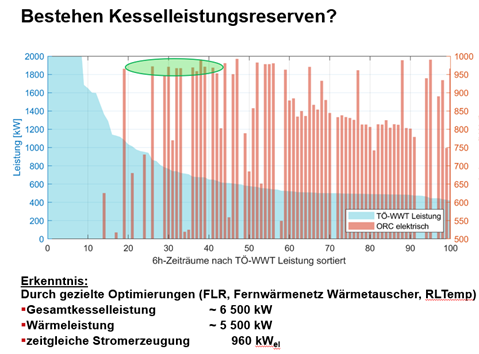
The analyses show that the existing biomass plant has considerable unused capacity reserves. Targeted operational and control technology optimizations can achieve a heat output of around 5.5 MW with a total boiler output of around 6.5 MW, while at the same time maintaining simultaneous electricity production of around 960 kWel. (see figure Boiler output reserves)
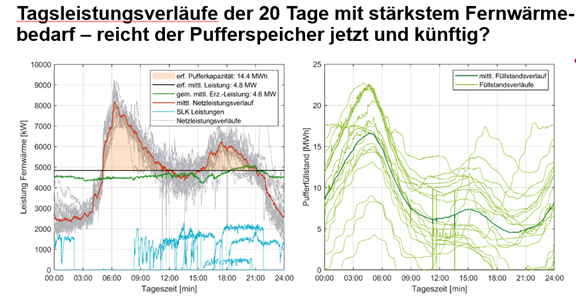
The existing buffer storage tank is basically sufficiently dimensioned, but has not been used optimally to date.
With optimized control, the majority of the additional heat demand can be covered by the existing system for all but a few weeks per year. It is not necessary to immediately build a large additional biomass boiler.
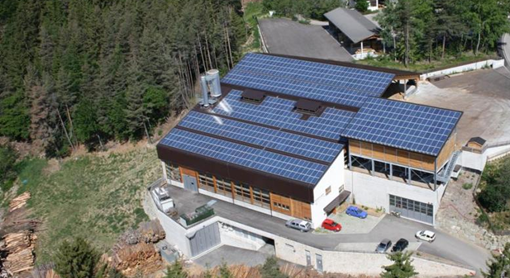
The Ritten bioenergy district heating plant is a cooperative in Klobenstein. The plant supplies households and businesses on the Ritten with district heating from biomass. Image source: Ritten district heating plant
Implementation
For the practical implementation of the optimization potential identified in the potential study, a higher-level, integrated control system (BCS® Suite) was implemented at the Ritten district heating plant. The aim was to design the existing plant technology in such a way that increasing network loads can be reliably managed without additional boiler investments.
Core of the implementation: Introduction of the BCS® Suite
With the BCS ® Suite, the existing plant was given a central, higher-level control system consisting of three closely interlinked modules: firing rate control (FLR), buffer storage management (PSM) and load hierarchy management (LHM)
These modules work on a model-based and automated basis, which means that the system can be operated safely, efficiently and with foresight even with highly fluctuating load profiles.
Operational impact of implementation
- Today, the plant can serve a connected load of just under 19 MW with a pure boiler output of around 5.4 MW.
- The buffer storage tank is used specifically to cover peak loads; the oil boiler is only used for maintenance purposes.
- Operation is largely automated and stable (“autopilot operation”), which significantly reduces ongoing personnel costs.
- The previously considered construction of a second biomass boiler could be permanently avoided.



Unsere Kunden