

PFAS in waste incineration: state of the art, study situation and regulatory uncertainties
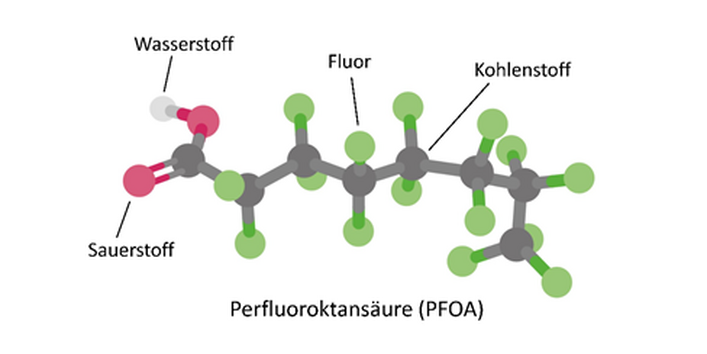
PFAS are chemicals that have a backbone of carbon chains surrounded by fluorine atoms (so-called C-F chains; see figure with molecular structure of perfluorooctanoic acid). If all carbon atoms of a molecule (except those at the end) are completely surrounded by fluorine atoms, the chemicals are called perfluorinated. If other atoms are also bound, the chemicals are called polyfluorinated. Source: https://www.umweltbundesamt.de/faq-0#was-sind-pfas
Per- and polyfluorinated alkyl substances (PFAS) – often referred to as “perpetual chemicals” – represent one of the greatest current challenges in environmental and waste management. Their exceptional stability makes them industrially valuable on the one hand, but also persistent, bioaccumulative and potentially harmful to health on the other. PFAS are frequently used in industry because they are extremely resistant to heat, chemicals and environmental influences. At the same time, they have a special molecular structure with a water-attracting part and a strongly fluorinated chain that repels both water and grease – this results in unique properties such as dirt repellency, non-stick properties and high resistance in demanding technical applications.
Against this background, the question of whether and under what conditions PFAS can be safely destroyed in waste incineration plants is becoming increasingly important.
PFAS in waste streams: relevance for thermal treatment
PFAS are found in numerous everyday and industrial products. They are particularly well known from non-stick coatings on pans and from foam extinguishing agents in fire extinguishers. However, water and dirt-repellent outdoor clothing, fast food packaging, carpets, upholstered furniture, waterproof cosmetic products and even electronic products also contain these persistent chemicals. Accordingly, they end up in relevant waste streams, in particular:
- Sewage sludge (typical: 67-114 µg/kg, max. up to 750 µg/kg)
- Waste paper and packaging materials
- industrial residues
This means that they are also a relevant group of substances for modern waste incineration plants – both in terms of safe destruction and possible emissions.
Study situation: between conservative assumptions and new findings
The scientific evaluation of the thermal degradation of PFAS has not yet been conclusively clarified.
Early research: focus on extreme conditions
Early work (e.g. Tsang et al., 1998) focused strongly on the chemical kinetics of particularly stable compounds such as CF₄ and derived very high necessary combustion temperatures (>1,400 °C) from this.
Current studies: Realistic system conditions
However, more recent studies paint a more differentiated picture:
KIT study (Gehrmann et al., 2024)
- Rotary kiln with realistic fuels
- Temperatures: 860 °C and 1,095 °C at 2 s dwell time
- Result: No new PFAS formation, no significant influence of temperature in the tested area
Urciuolo et al. (2025)
- Fluidized bed with PFAS-contaminated sewage sludge
- Result: 99.99 % degradation at 850 °C and 2 s sufficient
These results indicate that the usual operating conditions of modern plants in Europe already allow a very high destruction rate.
Role of modern plant and flue gas cleaning technology

In addition to combustion control, downstream flue gas treatment plays a central role. Modern flue gas cleaning systems that meet the legal requirements already ensure that the emissions from the complete combustion of PFAS (e.g. HF) are effectively separated.
The combination of:
- optimized combustion (temperature + dwell time)
- suitable fuel treatment
- Multi-stage flue gas cleaning
represents the current state of the art for the safe treatment of PFAS-containing waste.
Regulatory situation: inconsistent and changing
Despite new studies, the regulatory situation remains complex:
- No EU-wide limit values for PFAS in waste streams or emissions
- National recommendations vary
- Austria & UK: >1,000 °C or >1,100 °C
- German Federal Environment Agency (2024) explicitly recommends the thermal utilization of PFAS-contaminated sewage sludge
At the same time, the REACH regulation is expected to be adapted (2026/2027) with the aim of
- PFAS use to be further restricted
- Reduce input into waste streams in the long term
Practical evaluation: importance of analytics
Analytical methods are crucial for a well-founded assessment of specific waste streams. In practice, the following are recommended:
- AOF/EOF analyses
- “Sum PFAS-20” parameter
- Systematic sampling of refuse-derived fuels (RDF) and sewage sludge
These enable a realistic assessment of the load and form the basis for optimized system operation.

Conclusion
Current studies indicate that PFAS can be largely destroyed in waste incineration plants under typical European operating conditions. At the same time, there is still regulatory uncertainty due to the lack of uniform limit values and binding specifications.
Development remains dynamic – both scientifically and legally

Dipl.-Ing. Nora Fricko
Senior Process Engineer, CONENGA Group
Dipl.-Ing. Nora Fricko ist Senior Process Engineer bei der CONENGA Group und spezialisiert auf verfahrenstechnische Fragestellungen im Kontext von Energie- und Umwelttechnik. Ihr fachlicher Fokus liegt auf der Analyse, Optimierung und Weiterentwicklung komplexer Prozesse, insbesondere im Bereich thermischer Energiesysteme und ressourcenschonender Technologien.
Seit 2025 bringt sie ihre Expertise bei CONENGA in Engineering- und Optimierungsprojekten ein und arbeitet an praxisnahen Lösungen zur Effizienzsteigerung und nachhaltigen Nutzung von Energie- und Stoffströmen. Dabei kombiniert sie fundiertes theoretisches Wissen mit langjähriger Erfahrung in Lehre, Forschung und angewandter Technik.
Parallel zu ihrer beruflichen Laufbahn absolviert sie ein Doktoratsstudium im Bereich Verfahrenstechnik an der TU Wien mit Schwerpunkt Altlastensanierung. Zuvor spezialisierte sie sich im Rahmen ihres Masterstudiums auf Apparate- und Anlagenbau sowie chemische Technologie und Bioverfahrenstechnik.
Neben ihrer Tätigkeit in der Industrie war Nora Fricko viele Jahre als Lehrkraft tätig und vermittelte technisches Wissen in den Bereichen Wirtschaftsingenieurwesen, Elektronik und Informationstechnologie. Ergänzend dazu sammelte sie Forschungserfahrung als Projektassistentin an der TU Wien im Bereich Wassergüte, Ressourcenmanagement und Abfallwirtschaft.
Ihre interdisziplinäre Erfahrung aus Forschung, Lehre und Praxis ermöglicht es ihr, komplexe technische Zusammenhänge ganzheitlich zu betrachten und in innovative, umsetzbare Lösungen zu überführen.
Expertise
- Verfahrenstechnik und Prozessoptimierung
- Thermische Energiesysteme und Umwelttechnik
- Ressourcenmanagement und Abfallwirtschaft
- Apparate- und Anlagenbau
- Analyse und Optimierung komplexer Stoff- und Energieströme
- Technische Wissensvermittlung und interdisziplinäre Zusammenarbeit
Fokusbereiche bei CONENGA
- Verfahrenstechnische Analyse und Optimierung von Energieanlagen
- Entwicklung nachhaltiger Prozesslösungen
- Unterstützung von Engineering- und Innovationsprojekten
- Integration wissenschaftlicher Methoden in die Praxis
- Technische Bewertung und Weiterentwicklung bestehender Systeme